

 Risk Free Assessment
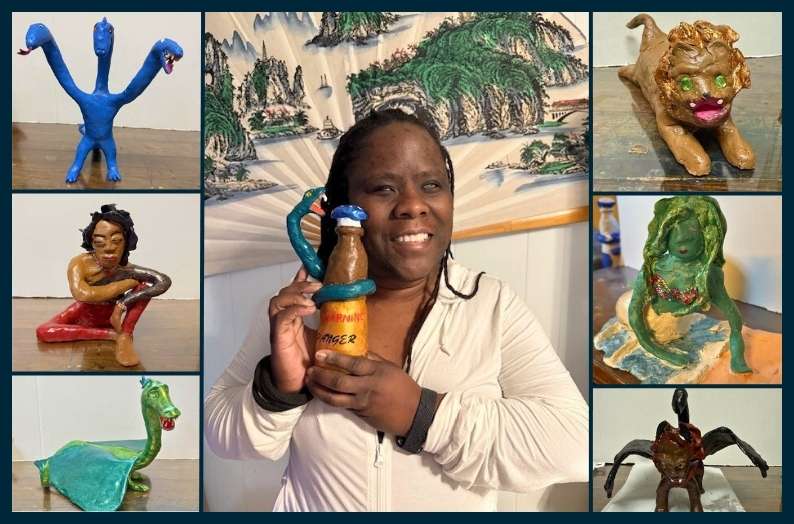
I recently had the opportunity to sit down and talk with Parrice Leach, an Ablr alumni who is an amazing artist on top of being an accessibility advocate, to discuss her relationship with art and how she is showcasing the power of art in the lives of people who identify with disabilities.
I didn’t want to talk to Parrice just because she’s blind and makes art. I wanted to talk to her because she’s someone who lost her sight later in life, stepped away from art for years, and then found her way back to it in a completely different way. Her story is honest, raw, and deeply relatable for anyone in the blind community who has struggled with vision loss, which often and mistakenly gets associated with their identity. This causes a fear that based on their disability, the things that they once loved to do may no longer be possible and for them.
I expected this conversation to be about her art, and while we discussed art in length, I also found that we discussed grief, resilience, and the importance of community in our lives.
Art Before Vision Loss
Art was always part of Parrice’s life.
“Before I started losing my sight, I would consider myself an artist,” she told me. “I sketched a lot—people, mostly women. Profile pictures, faces. I liked creating something out of nothing.”
However, that creativity didn’t stop at drawing. She also liked to sew. She made clothing, outfits for dolls, crocheted, painted, and even designed a dress that she still has! Her art was tactile and expressive.
When Parrice lost her sight, it wasn’t just about adjusting to her new situation and reality. It was about believing that she lost something central to who she was.
“When I lost my sight, it did hurt,” Parrice said. “Art was that one thing I had always done.”
At first, she tried to adapt. Using charcoal for contrast, working on larger sketchpads—but it never quite felt right and she felt her love of art slipping away. She noticed that she was drawing less and less.
“I wasn’t able to do what I used to do,” she said. “So I put it aside. It was a little depressing.”
Finding Her Way Back Through Clay
Art didn’t come back to Parrice through a big bang or breakthrough. Instead, it came back through her kids and the most random objects… Christmas ornaments!
She bought clay for her kids one year thinking it would be a good activity to make homemade holiday ornaments together.
“We just made different things to hang on the tree,” she said. “My daughter made a bird. My youngest made something that looked like a volcano. I made a little dragon.”
From there, clay became a way to create again. The process was handled slowly, cautiously, and emotionally.
She made Father’s Day gifts. A car for her husband. An elephant for her dad.
“I wasn’t really sure if I could do it,” she admitted. “But I was willing to try.”
She succeeded and experienced a wave of emotions that were complicated to process.
“I still felt sad,” she said. “As an artist, not being able to see your art is hard.”
Getting Past the Loss
One of the most powerful parts of Parrice’s story is how honestly and openly she talks about grief.
“A lot of blind folks have to get past the feeling of loss,” she said. “And in a way, it felt like a sense of selfishness.”
She explained that even when others praised her work, it didn’t fully register and even caused some doubts about herself.
“People would say, ‘Oh, it’s so good,’ and in my head I’d think, ‘Yeah, but I can’t see it.’ If I couldn’t enjoy it myself, it didn’t matter what anyone else said.”
That mindset became the biggest hurdle for her to enjoy art again and find the love she shared with art her whole life.
“It was getting past the feeling that if I can’t enjoy it, then nobody else should enjoy it.”
Through our conversation we learned that what changed wasn’t her blindness. Rather, it was her perspective. Not just on art, but life after vision loss.
“Sometimes enjoying something isn’t about enjoying it on your own,” she said. “It’s about enjoying it with other people.”
Creating for Joy, Not Perfection
Parrice leaned fully into clay sculpting, especially mythical creatures!
“I like mythical creatures,” she told me. “The stranger it is, the more challenging it is to make.”
The challenge became the point of emphasis for her.
“You do something you don’t think you can do, and when someone says, ‘That’s exactly what it is,’ that feeling matters.”
Currently, she loves the challenge of creating dragons, mermaids, and unicorns.
She’s also honest about expectations.
“I tell people, ‘I’m blind.’ That’s just reality,” she said. “If you’re expecting perfection, I don’t know what to tell you.”
Art, she reminded me, isn’t meant to be perfect anyway.
“It’s beautifully imperfect.”
Expanding from “Me” to “We”
Through Ablr, Parrice began shifting how she thought about disability inclusion and advocacy as not just as something affecting her, but as a shared experience.
“When you’re living a certain life, you think about what affects you,” she said. “But you don’t always think about the bigger picture.”
The program helped her move from an individual mindset to a collective one.
“I stopped saying, ‘This is what affects me,’ and started saying, ‘This is what affects disabled people.’”
That shift gave her confidence in advocacy and employment. After Ablr, Parrice was able to work with one of the world’s largest consulting firms and was a key team member in helping create the Infosys Tech Innovation Lab at the Discovery Place Science Museum in Charlotte, North Carolina. Today, Parrice has worked as an independent contractor testing digital accessibility for community colleges, producing remediation reports, and educating others about accessibility barriers.
She’s also pursuing a bachelor’s degree in recreational therapy, with a focus on helping people with disabilities engage with the world in meaningful ways by using creativity and accessibility as tools for independence.
Advice for the Blind Community
Parrice doesn’t sugarcoat the process of losing sight.
“Grief is a healthy part of it,” she said. “But don’t let it engulf you.”
Her advice is grounded and practical:
- Find a strong support system
- Surround yourself with people who treat you as capable, not incapable.
- Don’t let others take away your independence
“The only person who can really keep you from doing something you love is you.”
Redefining Art
Parrice isn’t just redefining art for herself, she’s helping open it up for others.
Through her involvement with the Durham Art Guild, Parrice focused on making art spaces feel more inclusive by focusing on the experience. She leaned into what she knew best: hands-on creation to make art accessible to everyone.
She led a clay sculpting workshop, bringing together parents, children, and community members for guided, tactile art experiences. In that session, Parrice showcased what it was like to create without relying on sight, helping participants shape, mold, and explore clay through touch.
“It doesn’t have to be perfect,” she shared. “It just has to be something you’re willing to try.”
That same approach carried over into her work with DIVAs Alliance, where she was invited to showcase her art at vendor conventions. She was able to sell and commission more art!
For Parrice, these moments mattered because they challenged the idea that art is something reserved only for people who can see it.
“Art doesn’t have to be something you look at,” she said. “It can be something you experience.”
Her work in these spaces reflects a belief that change happens through connection. By showing up, sharing her skills, and inviting others into the creative process, Parrice continues to redefine how people think about art, disability, and inclusion.
And for blind individuals questioning whether their passions still belong to them, Parrice’s message is clear:
You don’t have to abandon what you love. You may just need to approach it differently and bring others with you on that journey!