
 Risk Free Assessment
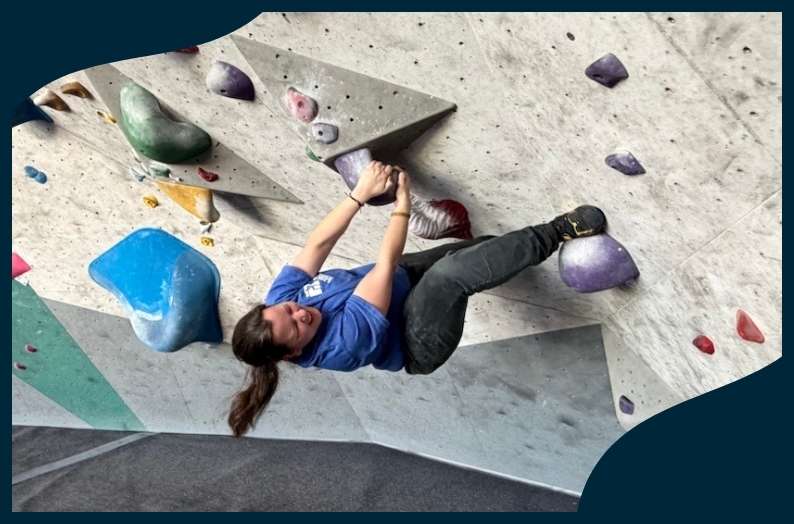
Leah’s story does not follow a traditional storyline. One of the key takeaways I have found working here at Ablr is that most of our stories pause, restart, accelerate, and have setbacks. However, and most importantly, they grow stronger. Leah Grosjean’s story is a perfect example of how to never give up.
When I spoke with Leah, we talked about more than just career paths or accessibility standards. We talked about the discipline of athletes, the weight and responsibility of being a single mother, and the “mildly irritating” reality of still having to explain why the world needs to be accessible in 2026 for people with disabilities.
Finding Your “Why” in the Dark
Leah has been blind for most of her life, but the last several years have been completely in the dark. In that same time, she has raised her eleven-year-old son, Josh, who is also legally blind. Oh by the way, she also works two jobs and has a spot on the National Climbing team for the United States!
When I asked her how she manages two jobs, motherhood, and a spot on the USA National Climbing Team, she gave me a reality check on the idea of motivation.
“Motivation is fickle,” Leah said. “When you’re tired, it goes away. And that’s when you have to rely on your discipline and your why. Why are you doing it? For me, a lot of it is my kid. I want him to know that even when things are hard, you still show up.”
The Wall as a Classroom
Leah is currently 4th in the nation as a paraclimber, but she had to learn to navigate the wall the same way she navigates the world: with patience and a different set of tools. She uses a “caller”. A caller is someone on the ground who acts as her eyes, calling out holds like “left hand at one o’clock.”
“I had to go down in climbing grades so I could learn how to actually climb,” she explained. “I had to learn how to move my body and how to use the holds. It took about a year of doing that before I actually felt like I knew what I was doing.”
One of the most important things she learned on the wall was when to stop. “I’ve discovered that resting even on the wall is important to continue being able to climb,” she said. It’s a lesson in sustainability that she carries into her professional life.
Accessibility Should not be a Luxury
During her time with Ablr, Leah found the language to advocate for herself and her son. She spoke candidly about the frustration of encountering digital barriers, like inaccessible documents or websites that don’t work with screen readers.
“It’s mildly irritating in 2026 that we still have to have these conversations about why things should be accessible,” Leah noted. “We shouldn’t have to go to our guides or friends to do the activities we should be able to do by ourselves. Why should they be our secretaries?”
For Leah, accessibility isn’t a luxury; it’s the difference between independence and having to rely on someone else for basic tasks.
What She’d Tell Her Younger Self
Leah’s advice to her younger self is rooted in the resilience she has built over years of navigating “the dark.”
“I would say it’s okay,” she told me. “The hard stuff you’re going through now is preparing you to go and do other hard stuff for fun later. Like, I go and climb walls for fun because I already did the hard stuff.”
Looking Forward
Leah is currently focused on training for the 2029 championships and helping her son transition into middle school sports. She refuses to let a job title or a diagnosis be the only thing people see.
“I’ve discovered that you can be defined however you want to be and your job doesn’t need to define you,” she said. “If your job pays your bills and lets you do the activities you love and that makes you happy, then go with that.”
From the USA National Climbing team to the digital accessibility space, Leah’s story is a powerful testament to the fact that inclusion is about more than just checking a box. It’s about creating systems that allow people like Leah and Josh to show up as their full selves.
Ready to take the next steps?
If you’re reading this and considering your own next step, we invite you to connect with us. Whether you’re looking to build new skills, explore accessibility as a career, or simply learn more about the work we do, there’s a place for you in this community. You can email us at Works@ablr360.com and visit our Ablr Workforce Development Program Page to learn more.