
 Risk Free Assessment
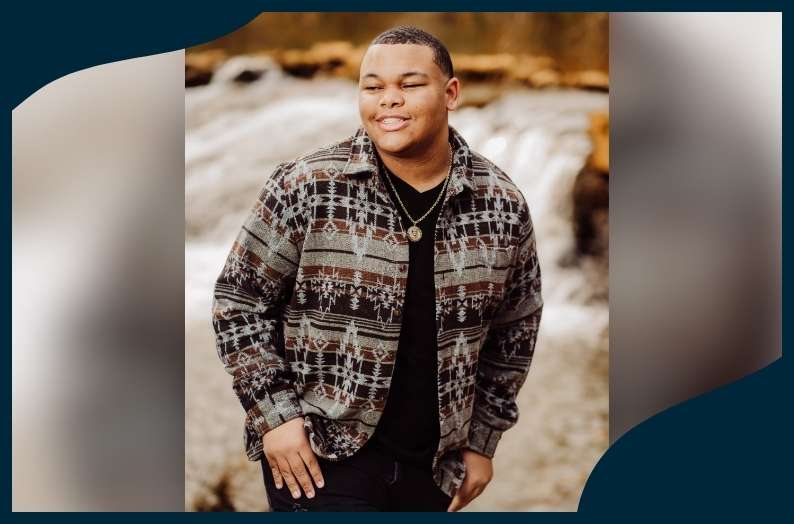
A conversation with Jabien Corpening
When I sat down with Jabien Corpening, I expected to hear about accessibility, career goals, and what comes next after high school. What I didn’t expect was a story that started with a doctor telling his parents something no family is ever prepared to hear.
This is a story about uncertainty, growth, identity, and what happens when someone learns to advocate for themselves in a world that does not always make space for them.
A Diagnosis That Shook Everything
Shortly after Jabien was born, a doctor performed a routine test by shining a light into his eyes. There was no reaction. No flinch. No response.
The doctor’s words were direct and devastating. His parents were told and this is a direct quote, that their son would never see the light of day or even their faces.
“It crushed them,” Jabien said. “It was heartbreaking… that’s life being flipped on its head for an entire family.” His parents were left trying to process what the future would look like. The unknown became very real.
The Moment Everything Changed
As Jabien grew older, something began to shift.
“They started to notice I was becoming more reactive to certain things,” he said.
Then came a moment when everything changed. Sitting in the back seat of a car, Jabien looked out the window and saw a truck.
“I noticed the logo… and I just said ‘Target’ and pointed,” he recalled.
His dad looked over, confused at first. Then it hit him. “He was awestruck,” Jabien said.
That moment challenged everything they had been told. It introduced possibility where there had once only been limitation.
Growing Up Without Limits
Despite the uncertainty, Jabien’s parents made a decision that would shape his life.They did not hold him back.
“I wasn’t restricted from really anything,” he said. There was protection, especially from his mom, but not limitation.
“They didn’t treat me any different… at the end of the day, I was their son,” he said.
Because of that, Jabien did not grow up focused on what he could not do.“I was just a normal boy outside of that,” he said.
That foundation mattered more than anyone could have predicted at the time.
The First Realization
Like many kids, Jabien did not fully understand what made him different until he started to see it for himself.
“I would have to say around eight or nine,” he said.
School looked different for him. He had a Braillist. He learned Braille. He received additional services.
“They tried to give me everything that I needed… just in case,” he said.
That realization brought something deeper than awareness.
It brought questions.
“You tend to ask yourself, ‘What’s wrong with me?’ or ‘How can I be like everybody else?’” he said.
He paused when he said it, then added something just as important.
“Obviously nobody is truly normal… but it definitely seems like that when you’re 12 years old.”
Finding Community at Governor Morehead
Everything began to shift again when Jabien attended the Governor Morehead School for the Blind.
“It was definitely something that I felt like I needed to experience,” he said.
For the first time, he was surrounded by others who understood his experience.
“It reminded me that this is a spectrum. This is something that can’t be put in a box,” he said.
That perspective changed how he saw himself. But that did not mean the journey was easy.
“There’s a lot of doubt… and there’s a lot of darkness behind anybody with a disability that just realizes that they’re different,” he shared.
Middle school is already a time when people are trying to figure out who they are. For Jabien, that process came with an added layer.
“It seems like it was turned up on 11 out of 10,” he said.
The Fight for Accessibility
Before Jabien learned to advocate for himself, someone else was doing it for him. His mom. Accessibility was not automatic. It was a constant effort.
“It meant fighting,” he said. “It was a lot of fighting.”
Meetings were frequent and accommodation was not always provided without pushback.
“Almost every other week my mom had to come down… and just fight,” he said.
She fought for larger print. For proper seating. For basic access to education. At the time, Jabien stayed quiet.
“I didn’t want to be a burden or a bother,” he said.
But staying silent came at a cost.
Learning to Advocate for Himself
At Governor Morehead, something shifted.
Jabien began to understand what self-advocacy really meant.
“I needed to find my voice,” he said. That realization led to a turning point.
“I needed to get on the front lines and fight for myself,” he said.
It was no longer about someone else speaking on his behalf. It was about ownership and confidence. It was about stepping into who he was.
Looking Ahead
Now a recent high school graduate, Jabien is stepping into his next chapter with purpose.
“I’m reminding myself not to compare myself to anybody… anybody’s journey or path,” he said.
That mindset is shaping how he approaches his future. As he explores digital accessibility, his focus is simple.
“I want to figure out where I can fit in… how I can contribute, and how I can set myself apart,” he said.
There is no rush to have everything figured out. There is just a commitment to keep moving forward.
What He’d Tell His Younger Self
When I asked Jabien what advice he would give to his younger self, his answer was honest.
“You can either stay stagnant and overthink… or you can humble yourself and surround yourself with people that build you up,” he said.
He spoke about the importance of support in a way that felt real.
“Sometimes you need that extra guiding light to walk into the next steps of your life,” he said.
And perhaps most importantly, he acknowledged something many people struggle with.
“I struggled with asking for help… and I still do,” he said.
A Message to Parents
For parents navigating similar situations, his message was simple and powerful.
“It’s not over,” he said.
Then he expanded on it.
“Today may mean something different, but a year from now it could be something entirely what you don’t expect,” he said.
It is a reminder that progress is not always linear and that outcomes are not always predictable.
What an Accessible World Really Means
When asked what an accessible world means to him, Jabien brought it back to something fundamental.
“Having everything that those in need… need,” he said.
He continued.
“Not having to fight or claw for simple accommodations or simple needs,” he said.
His definition was not about systems or policies.
It was about removing barriers so people can simply live.
Final Thoughts
Jabien’s story is still being written.
It began with uncertainty. It moved through doubt, growth, and self-discovery. And now, it is moving toward purpose.
But if there is one thing that stands out, it is this.
“Everything changes daily… and it’s never going to stay the same for long,” he said.
Sometimes the future looks nothing like what you were first told it would be.