
 Risk Free Assessment


In early March, I had the opportunity to take part in a webinar with our partner, Carbonhouse, about accessibility for theaters, arenas, and event venues.
These are the places where people gather for an experience – concerts, plays, sporting events, and performances that bring communities together!
But before anyone enters the building, they almost always visit the venue’s website first – it’s like the virtual lobby!
However, if that virtual lobby isn’t accessible, then many people might not ever get to that special experience. Well, that exact situation was the reason for my relationship with Carbonhouse!
In 2019, one of my blind colleagues wanted to buy tickets to a play at a local performing arts center. She was excited about the show, but there was a problem: the website wasn’t accessible.
She couldn’t navigate the ticket purchasing process with her screen reader. Eventually she told me she would probably just miss the show.
That didn’t sit well with me!
So, I reached out to the venue through their contact form to let them know about the issue. Almost immediately, I received a response from Brandon Lucas, the President of Carbonhouse.
He asked if he could call me.
That conversation could have gone two very different ways. He could have told me the site complied with accessibility guidelines and started quoting technical standards (I’ve had plenty of those conversations before!) In those situations, my experience has been that people talk “at you” rather than listening to the real experience.
But that’s not what happened.
Instead, Brandon was genuinely curious. He wanted to understand what it was actually like trying to navigate the site without sight.
That conversation turned into a partnership between our organizations – and more importantly, a friendship!
In the Summer of 2019, a few months after Brandon and I had connected, he invited me to speak at the Event and Arena Marketing Conference in Toronto.
The timing couldn’t have been better!
The night before our talk, the Toronto Raptors defeated the Golden State Warriors in Game 6 of the 2019 NBA Finals.
Even though the game was played in Oakland, Toronto erupted in celebration! Fans filled the streets across the city.
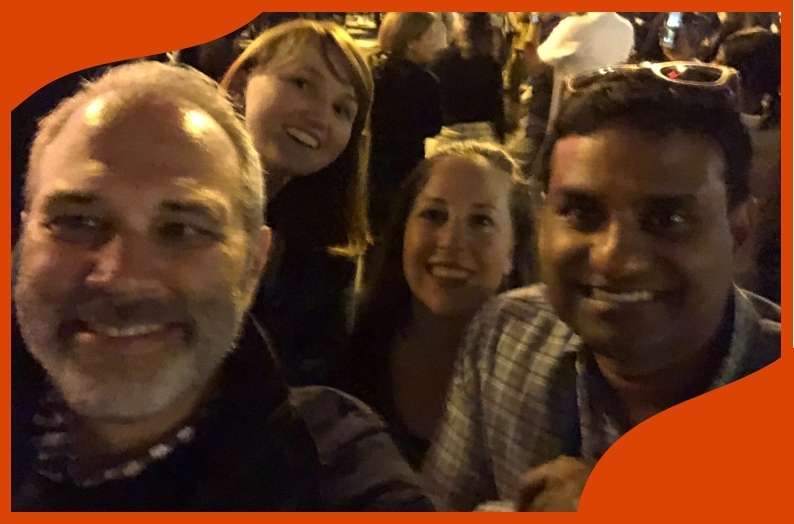
Brandon and members of the Carbonhouse team insisted we go out and experience it.
I’m incredibly glad they did!
Seven years later, it’s still one of those foundational memories for me – being surrounded by thousands of people celebrating together!
While walking through the crowd with my white cane, one very enthusiastic Raptors fan (who may have had a few celebratory drinks) stopped me and asked:
“How is this experience for you?”
That question has stuck with me ever since.
Because that’s the exact question organizations should be asking when they think about accessibility.
Whether you run a theater, arena, or event space, (actually any business for that matter!) the most important accessibility question isn’t about compliance – It’s this “How is this experience for you?”
If more organizations asked that simple question, we would have far more accessible websites – and far more people enjoying the arts and live events!
During our webinar, we talked about a lot of topics, including the role of automated accessibility tools. These tools can identify common issues such as missing alternative text, color contrast problems, and missing form labels. They’re fast and helpful for monitoring websites, but automated tools typically detect only about 30–40% of accessibility issues.
For event venues, the issues they miss are often the ones that matter most:
- Whether a screen reader user can actually purchase tickets
- Whether seat maps are usable without a mouse
- Whether error messages make sense
- Whether the checkout process follows a logical flow
Human testing is essential because it focuses on real usability – the human experience! It answers the question that ultimately matters, “Can someone independently buy a ticket to tonight’s show?”
This led into another key topic , the difference between accessibility and usability.
Accessibility asks “Can someone access the website? But usability asks, “Can they use it efficiently and confidently?”
For example, a seat map might technically work with a screen reader, but if it takes me to tab through hundreds of seats just to find one available ticket, that experience isn’t truly usable!
Imagine if it takes me 20 minutes longer than someone who isn’t visually impaired to complete a purchase. I might miss early-bird pricing, or I just might abandon the process altogether, just like my colleague!
Remember, that accessibility will get someone in the door, but it’s Usability that will make them want to come back!
At the end of the day, accessibility isn’t about checking boxes or a line of code – but it’s about human experiences and the feeling that everyone belongs.
Venues exist to bring people together for shared experiences – concerts, performances, games, and celebrations. But if the digital experience isn’t accessible, some people never even get the chance to join.
Sometimes improving accessibility doesn’t start with new technology or guidelines, but in many cases, it starts with a simple question “How is this experience for you?” Because when organizations truly listen to the answer to that question, better experiences follow for everyone!
Ask the Ablr team, “how is this experience for you?” and our team of human analyst will help make sure that the answer is always a resounding “great!”