
 Risk Free Assessment


A New Chapter for Ablr Transcript
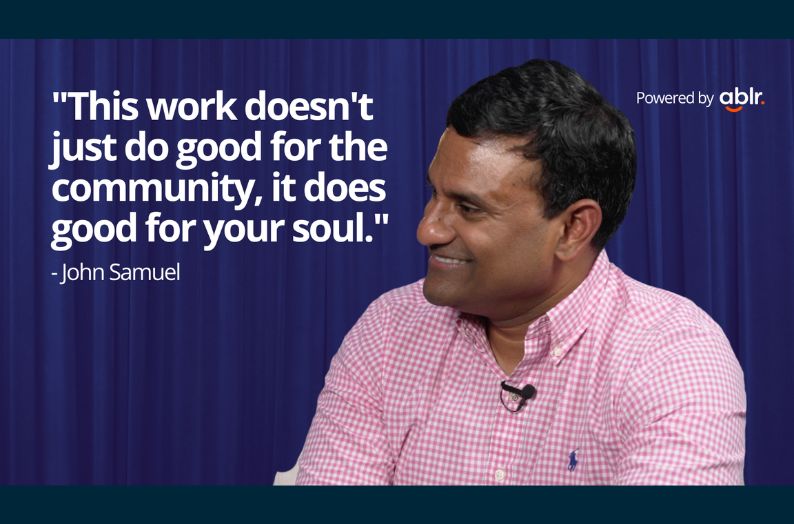
“This work doesn’t just do good for the community, it does good for your soul”
– John Samuel
Mike: This work doesn’t just do good for the community, it does good for your soul. And you said this from day one, we built a company that can sustain without us, and we have done that.
John: I know that the impact that y’all are going to make on the community is going to be real, and I can’t wait to see that impact on our state in North Carolina and across the country.
Mike: I think the biggest thing that I’ve learned is.. The state is acquiring an amazing person, and you’re going to create an environment where all people with disabilities are going to flourish. I’ll be surprised if you’re not governor in five years. The mission of Ablr continues because…
Welcome, y’all, to another episode of Access Granted. Today is a special day. I’m here with co-founder and CEO John Samuel. Today we’re going to talk a little bit about John’s future role, some decisions he’s made to move forward in a very new direction, which I’m so excited to share with y’all. And we’re also going to talk a little bit about the history of Ablr and reminisce a tad over the last six years of what we’ve done together as an organization, the people’s lives that we’ve been supporting and growing, and our incredible team at Ablr and LCI.
So sit tight. It’s going to be a fun conversation. I can’t promise you there won’t be any tears, but we’re going to get into it here in just a minute. But ladies and gentlemen, the man of honor, John Samuel, Mr. Johnny Sam. Say hello, Johnny Sam.
John: Thank you, Mike. I appreciate it.
Mike: So John, most importantly, I’d like you to share a little bit about what you’ve decided to do, and talk a little bit about why.
John: I’ve made the decision to join the Division of Services for the Blind as their new director, and it’s in the state of North Carolina. And it’s a role that means a lot to me because my career over the last nine years has really been driven by making an impact on our community, the blind community in particular. This new role gives me an opportunity to do that in another way.
Mike: It’s been an amazing six years, probably a little bit longer than that from before we launched this company, and what we’ve done is, this organization has done for LCI, for the community, for everybody, has really been life-changing, and has been personally been life-changing for me. You remember when we first met six years ago where I was, and frankly, where I was just last year too.
John: Yeah.
Mike: So I wanna say that one, thank you, brother. Like, you have been my closest confidant, man and this is a very positive thing. The first thing I thought of when John said this was, “We need to celebrate.” John has done so much for this community, and obviously, get the book, “Don’t Ask the Blind Guy for Directions”, but it talks about John’s life. I’m excited for you because this really is a celebration for the community and for the state and for John and his family. What he has committed his life to is not about himself, and it’s about others, and honestly, that is the most inspiring thing I’ve learned from you, my friend.
John: I appreciate that, Mike, and this has been an amazing journey working side by side on this and with our team. It’s been a dream come true. There’s no better job or role than to be part of the Ablr team and do what we were doing. And I know that it’s going to continue, and under your leadership, I know it’s the right time to be able to have that change. And with Kim Casey, who’s going to be our Chief Operating Officer, you guys are going to do an amazing job together leading that team, and I know that the team is going to continue to grow and reach new highs that we never even thought possible.
Mike: Looking at what has transpired from those last two years and where we are today because of your leadership, because of your friendship, and we had hard conversations, brother. Yeah. These were not easy ones to have. I feel excited about what we’re doing as a company, and I know it’s still fresh and new, but when you said it, I didn’t have that fear. I immediately started thinking about, “Okay, how do we move forward with what John has created and this mission, and how do we carry that forward?”
My brain started filling it with ideas and opportunities and a very positive mindset because John has always said, “We’re building a company that we’re not going to be part of someday. It’s sustainable on its own. If you ever build a company that’s dependent on a person, you don’t have a company.”
And our company flourishes independently, and I think we can find and replace people, and we just keep rolling.
And it’s also a comfort in knowing that our team now has such an amazing opportunity to take sort of the torch that you’ve lit and carry this in much deeper, much further with your support from the outside. We’re going to see some amazing things over the next few years together with Ablr and with our partnership.
And I’m just wondering, what is your memory of the first conversation that we had? What were your semi-honest thoughts?
John: It’s funny that you bring this up, ’cause when I was making the decision, I went back through old emails and to look back at the history, what was going on back in 2019 when you and I were first connected. And, you know, I had developed a relationship with Walk West and Donald Thompson, and there is an email that, Kurt from the team over there had sent and said, “Hey, I wanna introduce you to, Mike Iannelli, who heads up our partnerships.”
And so that was the first introduction, that email. The sheer number of emails I got from you. There was this email after email after email from Mike. I was like, “Oh my gosh, just so many emails. This guy really wants to meet me.”
And, there’s these things that come out of it, and I remember you coming in, and I remember you not knowing what to do, and those kind of parts of that relationship.
But it started on that email. It turned into something real when, you came into the office to me. That’s the memory I choose to remember.
Mike: You know, I think we both were excited to do something new. We also were carrying significant burdens of success or die scenarios for a long time. A true partnership, in my opinion, fights through all the storms.
John: Yeah.
Mike: Not just the ones that are comfortable, not just the ones that are self-serving, but you really put yourself in front of others for the good of the mission, which was always number one, even in our bad times. I’ve said it for years and I’ll say it again, it’s been the absolute most beautiful, amazing professional experience of my existence.
I don’t see it ever being topped. Again, you come from me, right? Agency guy, “Hey, we’re going to do this. We’re going to do that,” you know?
And then I’ve been become a humbled servant, man. So I remember when we met the first time, too, and John came out through the doors, and I didn’t think he was blind. I was like, ” This guy’s not blind,” ’cause I didn’t know anything about blindness. But I remember going back and John told me the whole story, and he took me through this tour, which we’ve talked about for years, of the facility over at LCI, which is amazing. But I remember hearing that screen reader, and that was sort of the first thing my recollection of saying, “I need to do more.” All of those that are listening to this, I highly recommend, before you go too deep in your career, that you give nonprofit and mission work a true, true chance, because it will change you from the inside out, and it serves others. And ultimately, in the end of the day, that’s what we’re here to do. So I do remember that.
So John, when we’re looking back, you know, all the VTOs and all the meetings, is there anything that you felt… And this is an interesting question, ’cause we talked a little bit about it. Is there anything you felt that we radically underestimated in our venture?
John: Oh, that’s a great question. Well, I think when we were building out the company, I think the idea that we’d be able to generate business faster.
It was looking at it from a sustainability model, trying to figure out how we would get there. And I think that it’s one thing to put numbers on an Excel sheet, and then adjusting those numbers to make it look good versus the actual boots on the ground getting the work done. And I think that was the first thing that took some understanding. And that took us going from having a bigger team down to a smaller team.
And getting the right people in the right seats. The second thing I would lean is the power of a brand. Starting, we were LCI Tech, and took the LCI logo and just added Tech on the back end of it. And I didn’t realize, when we created the Ablr brand and we started to use that, the amount of attention just from our brand really changed. It was almost like, “Oh, wow. We’re going to have John Samuel from Ablr speak now.” That was a different, I don’t know the right word, gravitas or something that came along with having that brand behind. And I think that gave me more confidence, and I think I underestimated the value of having a brand behind you to be able to help get our voice and our mission out there.
Mike: Yeah, well said, man. I think what we’ve done there is we’ve created a culture in this company that, and the mission, and hiring the right people in the right seats and having the right support from LCI. We’ve really created a really lovely organization that is delivering results, but doing it not only with a smile on their face, but with authenticity, being genuine, being kind, being thoughtful, being candid.
It’s been amazing because the echo of this brand that you were referring to really spreads. My kids were telling me they were driving somewhere at the beach and someone had an Ablr shirt on. And I was like, “What’s up?” You know, we made it to the beach, and now we’re out to the West Coast. Now we’re working with companies in Europe. All right, so what failure ultimately became one of your greatest lessons?
John: I think the failure between you and I a year and a half ago. That failure in a communication I think caused us to stop and slow down and really understand and get realigned. We did the exercise of, ‘Stop, Start, and Continue’ and I think that really helped us. And from there, I think we’ve had our greatest success, ’cause like I think our team and our business does better when you and I are aligned, and that’s the greatest success. And I think that’s what gives me the confidence to be able to make my next move at this stage in the business, because I know that the foundation is strong and that you’re in the right head space and that the team is in the right place to be successful.
Mike: If you could go back and give one piece of advice based on what you’ve learned, what kind of piece of advice would you give yourself?
John: I was not a very trusting person at that time. I had to become more vulnerable. It was one thing I became vulnerable sharing my story with people, but it was one thing being vulnerable with the team to say, “I don’t have all the answers, and I need support,” and to be able to have that.
And that’s what I would say, is be more vulnerable and build trust within the team sooner than later.
Mike: Understandable why, though, but yes. Are there any specific wins that you remember? You know, maybe if you can come up with three, just ’cause it’s been a long time, that maybe, that you remember the kinda, “Wow, I think we’re onto something. Wow, I think we’ve got this.” Are there any things that you can think of over the years?
John: Yeah, I think one of those was when we got the North Carolina Board of Elections. That was like our first big contract, ’cause it was like, “Oh, we now have a real deal contract.” And that came from the community referring us as the partner.
And that one contract was bigger than everything we’d done everything combined. And I think that, going back to even Marian Treaty and the community colleges, when we got the disability inclusion training rolled out..
Mike: That was big
John: it was big.
Mike: That was big. And that relationship still is just such a beautiful one.
John: Yeah.
Mike: And I still meet people today from different community colleges that are like, “Oh, I’ve taken your training.” And that’s the beauty of it. How many people do you reach? And it’s like, I think I would agree, that’s the day when I thought, “This is going to become a global mission,” because now we’ve got Ulta, then we went to Manscaped, then we transferred into Lenovo and Motorola. And these organizations, yeah, the names are big, but it’s the people at these companies that actually care, the compassion, the empathy, and the desire to do something outside the box.
John: Yeah.
Mike: Do something that matters in these big companies, and I applaud those people. That’s frankly how the podcast got started. That was the whole purpose of the podcast, was to share the stories of our clients.
John: But the last one I would say is, I remember we got the contract for our Workforce Readiness Program at the State of North Carolina. Yeah, I knew that was coming. And we got the contract, and within the next week we had our first class. It was like really building the plane while flying it. At that point I knew we had this can-do attitude. That’s the kinda grit that we needed. And again, those are some of those moments I’m like, “This is it. We got something real. We can train people. Now we can help put them in jobs.”
Mike: A lot of these accomplishments you’re talking about, people see them, but when you go home at night and you’re chilling with the fam and you think about something, like, that people haven’t seen?
John: To me, the graduations, to see the families, that’s something that a lot of our rest of our community don’t get to see. They don’t get to see what actually happens, the love that’s in that room, the parents, the family who are so proud of their child, their partner, their parents, their brother, their sister, right?
You know, when those graduates complete the program, and just that sense of accomplishment, that’s something really special.
Mike: Going back over each graduation, and the rec centers were fun. And then, one of the things that jumps out to me is the train station, Union Station, when we did GAAD that year. We’ve had a lot of crazy GAAD. GAAD at Pendo was amazing with 321 and Lindsay. That was another one that kinda was like, “Man, we walked in there, we had 120 people in there.”
It was like, so many people care about what we’re doing. That was a big deal. And then the following year we did Union Station, and you and I kinda with Sarah, we kinda just rolled with it, but it was such a cool setting. Had so many people out there supporting our mission.
John: Yeah.
Mike: We were talking the other day with, North Carolina Controller’s office. Michael came up to me at GAAD this year at SAS, and Michael will tell you, he doesn’t show a lot of emotion. For him to come up to me in the back of the room and just whisper in my ear just how grateful he was because he said same thing that I said, “This work doesn’t just do good for the community, it does good for your soul.” And it’s changed his whole life, he said, not the way he leads people, the way he goes home at night, the way he thinks of others. Like when I hear those stories, that is the bee’s knees right there because that means you’re making an impact.
All right, so let’s shift into leadership a little bit. We got a couple questions here. What are a few qualities that you would give advice to for any mission leader?
John: First, you have to believe in your mission, and if you don’t really understand and believe in and feel it, you can’t genuinely and authentically bring your full self to the business. So that’s the first step, right?
And two, we talk about it at LCI a lot, that margin equals mission, going back to what you talked about. You can’t let the mission blind you in some ways, right? You have to be able to find that sustainability. You have to find that balance of, like, being able to do what’s right for the mission and then also make sure that you’re making business sense.
Mike: Yep.
John: Finally, I think that it’s important to relook at your mission constantly and you know, sometimes when people feel like they have a good mission, they’re like, “Oh, we have a great mission.” But if you don’t have a plan to execute that mission.
Mike: Then you’re burning the mission.
John: That’s right.
Mike: Yeah, so it’s a lot of more backing that up with, obviously, operations, business, strategy. But also you can’t have a mission if you don’t have margin.
John: That’s right.
Mike: Even if that margin is very small, it doesn’t matter.
John: ‘Cause the best of missions can disappear. But can you share, what are some of the lessons that you learned over the last six years that you think that are going to help set you up for success as you take on this new role?
Mike: There’s a lot over the last six years.I think the biggest thing that I’ve learned is to really let go and let God, and just, look, I can only do what I can do. As long as I make a commitment, as long as I work hard, as long as I try to do it the best I can with kindness, respect, integrity, the rest will come. When people call what I do selling, I find it to be insulting, because and you know a little bit about my past with selling, but I try to help people whether they decide to work with us or not. It’s more of a consultative sort of leadership role. But to balance out having to lead the brand is what I did with it or could do with it, and then having the desire to wanna be a leader and grow and do all the things that I knew I was lacking, but trying to find that with the balance of keeping the business moving forward fiscally was one of the, probably the most radical challenges. And so that would probably be the biggest lesson.
John: How are you going to take those lessons learned and bring it into your new role?
Mike: I’m going to say this, and I hope this comes across the most respectful way, but being behind you and letting go of who’s going to do what, and what roles are what, and just letting go of that and just saying, “Dude, I’m honored to just work with you and support you.”
That took a long time, and I think you know we’ve had some of those discussions in the beginning. But being able to be behind the scenes and just get to know our partners and our relationships, being humbled, and I mean that in the most respectful way of saying, it’s not your time, and it doesn’t need to be.
You’re here for the mission. You’re here for your partner, and being really selfless. I know that I’m not perfect, y’all. I still am not great in a lot of ways, but the recognition of it, I think, is one of the most important parts. But being able to watch you, the way you carried yourself from, frankly, from day one, the utmost professional, by the way.
I mean, the dress, dialed in for sure. But what I’ll carry into this is, is one I’ll carry our mission forward, day one. And that’s the beauty because I’ve been behind it and living it for six years, and I’ve never felt more confident, more excited. I can see the vision of where this company is going. I will carry that.
I think that’s the other beautiful thing about this company, is that this isn’t a John and I. Everyone has a voice in this company, and we listen. And so listening to our team, empowering our team, going to bat for our team. Not say defending, but supporting our team in tough times. But also, there’s a personal component to that, too.
You know, business is business, but when you spend 8 to 12 hours a day with people. When they leave the office, that still matters.
John: What do you see for the business over the next year or two, and how do you give that comfort to our partners and to our team to say, look, we’re on the same right track?
Mike: I think accessibility will continue to evolve regardless of what tools come around, what AI comes around. I think we will continue to build out a core set group of organizations and partners that want to do good, and that’s the beautiful thing. When you find people that have that yearning to do good, no matter where they are, they’re going to do good. And I think we’ll continue to grow that out, evolve some of our technology, evolve our service levels.
I think there’s a few other different things we might bring to market that will be exciting. But if you ask me the biggest growth I see in our pre-employment transition services with Jess at the helm, I see with our workforce development program, we have built the foundation, and I think we have figured out the most optimal way to find, to align, match-make the right companies with the right people.
I think our training has gotten better and better and better. I do see more training come along, more services offered, and I think that we’re going to see and create, help create the future leaders of this country. Our AI Essentials program, which just getting off the ground, I think that is going to be a massive lift for us. I know that sounds bizarre because usually when an organization loses a key member of the team, especially the CEO, there’s always this feeling of, “Oh, no!” But as John mentioned, and he said this from day one, we built a company that can sustain without us, and we have done that. And we will miss John radically, but I think our team is ready. I think our clients are ready. And I think you said it perfectly, sometimes change needs to happen even though it’s uncomfortable.
John: I know that you guys are going to do great. That is a something I know from the bottom of my heart that the team is going to achieve that tripling the growth. I know that the impact that y’all are going to make on the community is going to be real, and I can’t wait to see that impact on our state in North Carolina and across the country. And I would never have left if I didn’t think that the team could do better without me, and I know that’s going to happen.
Mike: You’ve led us in so many different ways. There’s a old part of me inside of my head that’s saying, “Oh, be afraid,” or, “Oh, be afraid.”
John: Nope.
Mike: There’s none of that. It feels right for everyone.
John: Yep.
Mike: The state is acquiring an amazing person, and you’re going to create an environment where all people with disabilities are going to flourish. I’ll be surprised if you’re not governor in five years. But I think you are on your way to just amazing, amazing things, brother.
John: I’m super excited as you step into the new role as CEO, take the lead of the organization, and guide them into the next stage of our business. What are some of the things that you are most excited to help the team and our clients as you become the CEO?
Mike: I think there’s a lot of things that will be continuation, right? Just maintaining sort of what we built as an organization as a partnership. We’re going to have a really exciting few months because we’re going to get a sense of pressure testing the organization, which we’ve been through before. We’ve talked a little bit about right seats, right people.
John: Yep.
Mike: I think we’re there, but we’ll find out very soon who is really committed to the mission and really taking this company to the next level. And again, I feel like we’ve got the team. We’ve got a couple new roles that are opening up, which I think are going to open to the doors. I think a big part for me, what I can bring, what we’ll bring to the table, and again, I hope I can do this role justice, is really the leadership aspect of it.
The nuts and bolts of it, I’m happy to do that, step in and do that, and luckily I have six years of history with our business and what we’ve done. But I think it’s really, what I’m hoping is empowerment, team empowerment. I keep going back in my head ever since this was announced was how can we do the work that we do at the highest level that we do with the resources and team that we have? It’s not a surprise we don’t have a huge team. We haven’t ever had a huge team, and I think that’s the beauty of Ablr, is that we kinda work within our means. But I think in order for us to get to that true next level, breaking through the ceiling, is really with our team. And I think what people take away from Ablr is, again, what we’ve always seen and heard is we are a mission-driven company that actually cares about what we do every day. I’m ready for the challenge.
I think we will find new ways to generate revenue and growth. We’ll find new community partners and extensions of all the amazing relationships we already have. I think we’re just on the forefront, truthfully, of our community engagement. You know, I’d come in in the past with the mentality of just keeping us moving, keeping us moving. But the more we take a step back from the keeping us moving and thinking about what pockets that we can actually impact, we are all about intentional, meaningful collaborations, and we’ve said this from day one, we cannot do this without you, and that means everyone. And so I feel very comfortable, very excited, but I feel like you’ve laid an incredible foundation.
You’ve mentored me. You’ve provided me with the leadership that I need. You’ve helped me through some radically difficult times in my life that I feel like I’m ready and we’re ready, and I think this is going to be a beautiful step for the company.
John: Another change as you’re moving into your new role, we’re also going to be elevating Kim Casey into the Chief Operating Officer. And so how do you see yourself working with Kim?
Mike: Kim has been the catalyst, true catalyst of this company. I mean, we’ve been the co-founders, but we hired well with Kim. And so Kim, not only has she secured our processes, she’s been leading our accessibility team. She’s now moving into a new role as our Chief Operating Officer. I think together she and I, with your foundational piece that we’ve talked about, I think we have a very good understanding of what we need to do, when we need to do it, and why we need to do it. And Kim will drive a very large percentage of that for our business.
John: And I think that the two of you are going to do some great things together, and I can’t wait to see what happens.
Mike: What are you most grateful for over these last six years?
John: I’m so grateful to LCI. They resurrected my career. LCI gave me an opportunity that it was almost like it was just written for me, right? It was like, to be able to come and start a new business that I didn’t have to go in and fit into anyone else’s mold, but to build a business. How many people get that opportunity?
Mike: Not many.
John: To say, “Go start a new business and we’re going to pay you a salary, and we’re going to give you a retirement and pension.” The support that I had to just think and do is something I’ll be forever grateful.
Mike: LCI kinda saved your life and direction, sort of Ablr saved mine and my direction. And I hope and pray that other people that follow in Ablr’s footsteps will say the same thing about their life. If you could speak directly to every participant whose life has been intersected with Ablr, what would you say?
John: Thank you for allowing us to be there with you, and I know you’re going to do great things. And I can’t wait to have you pave the path for more people who are going to be coming behind you. And thank you for trusting us.
Mike: I’m going to really miss our golf outings.
John: Yeah.
Mike: And our bowling outings, and all the things that we’ve done. This is not an end, this is a beginning.
John: That’s right.
Mike: So finish this sentence for me. The mission of Ablr continues because…
John: We have the right team to bring hope and love to our community.
Mike: Well said, brother. Thank you, my friend.
John: Thank you. I love you.
Mike: I love you too, man. Give me a hug. Proud of you.
John: Proud of you.
Mike: The future is so bright, my man. It’s so bright. Thank you for helping me, brother. Mm-hmm. All right, that’s a wrap for this.