
 Risk Free Assessment


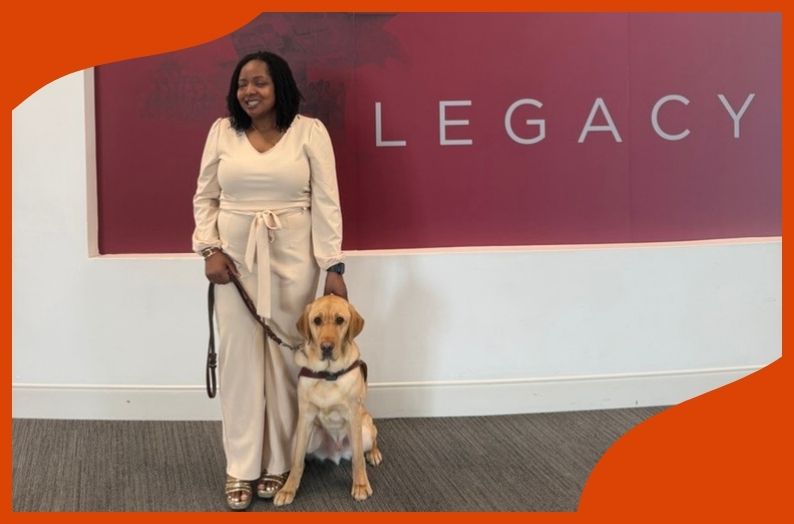
Shannon Garner is one of my dearest co-workers and I have admired her ever since I joined Ablr. I was excited when she agreed to meet with me to discuss her journey and thought process of getting a guide dog. I knew I wanted to talk about guide dogs and try to understand what it was like to make the decision to get a guide dog. However, this conversation quickly jumped to something deeper and more profound. We spoke about personal freedom and independence.
From losing her vision at just six years old, to learning how to travel independently with a cane, to eventually finding her first guide dog, Tracker, Shannon’s journey has always been about finding new ways to keep moving forward and not letting things slow her down. And sometimes, that journey starts with paws on the pavement.
Learning to Move Forward
Shannon was only six years old when an illness changed her life forever. After developing an extremely high fever and being hospitalized, she woke up unable to see.
“I couldn’t see. I couldn’t see.” Shannon recalls yelling and asking for her mother.
Her mother eventually explained what had happened.
“Your eyes, you were sick, you were very sick for a while, and your eyes are not going to be the way they used to be.”
Shannon’s vision never returned.
“But it’s okay. It’s okay. You know, but that was a new life for me.” Shannon said with a smile.
Looking back, Shannon believes experiencing vision loss at such a young age helped shape the person she would eventually become.
“I am grateful that it happened when I was younger because of that, I have been a lot more resilient and adjusted into a life with no vision.”
That resilience became especially important as Shannon first learned how to travel independently.
Finding Freedom
Long before Shannon considered getting a guide dog, she learned how to travel with a cane.
“Dr. Kirby Green made sure that I was an awesome cane traveler.”
Through years of orientation and mobility training, Shannon learned how to listen to her surroundings, navigate unfamiliar environments, and most importantly, trust herself.
“Because of that tough love that I got from Dr. Kirby Green and learning how to listen to my surroundings, learning how to use my cane properly and not being afraid, it really is still something in me saying I still can travel.”
Then she met Morgan, a guide dog belonging to a friend. “The very first time that I was like, I want a guide dog is, you know, when I met my friend, her name is Shannon, and she had a guide dog named Morgan.”
Still, she wasn’t ready. “I kept telling myself, not right now, because I felt like I wasn’t ready.” That changed when she met another guide dog named Trenton.
“It was just so freeing. Just to have your hand on the handle and just take off.”
Shannon knew she was ready. “I was like, you know what? It’s time.”
Finding Tracker
After researching guide dog schools, Shannon eventually found Guide Dogs for the Blind and began the process of finding her first guide dog. Then came Tracker.
When Shannon first walked with him, something immediately clicked. “It was just a very natural partnership from day one with Tracker.”
She remembers that first walk clearly. “It was the walk. It was the walk. It was so smooth.”
“He did all the stops perfectly, all the turns perfect. You know, my footwork and his guiding was just amazing.” She didn’t need another dog.
“I said to them, I said, this is it. I don’t want to touch any other dogs. I don’t need another dog. It’s us.” Shannon and Tracker graduated on October 8, 2016, beginning a partnership that would last nine years.
“We had nine years of awesome partnership together and I couldn’t ask for a better first guide dog. Just amazing, amazing dog.”
When It’s Time to Say Goodbye
Eventually, Shannon had to make the difficult decision to retire Tracker.
“I was going through the motions of, do I want another dog? Tracker is so perfect. And it was a really hard decision for me.”
She ultimately decided Tracker deserved the opportunity to simply enjoy retirement. “I decided once he turned 10 years old, I was going to give him time to just be a dog, just be a pet.”
Even though Shannon was an experienced cane traveler, she knew something was missing. “I’m an awesome cane user, like a cane traveler. I can travel with a cane just fine. But there’s just something different about that freedom.” She decided it was time for another guide dog.
Shannon now has Tennessee, a fireball of a lab who is leading her into new adventures and together they are bringing advocacy in real time to the people she meets. Their story has only begun!
Advocacy Comes With the Leash
Being a guide dog user has also given Shannon countless opportunities to advocate for herself and educate others.
“As I’ve gotten older, I’ve learned just from life experience of how to advocate for myself.”
She understands that not everyone is comfortable around dogs, but she believes education can change those interactions.
“People are terrified of dogs. But if you take the time out and educate, because sometimes that’s what it takes.”
Shannon has experienced this firsthand with rideshare drivers who were hesitant to allow her guide dog into their vehicles. After speaking and educating the driver, she later heard the same driver advocating for guide dogs.
“It’s that fast, that fast. I spent maybe 20 minutes with this guy.”
For Shannon, advocacy isn’t always about confrontation. Sometimes it’s simply about taking the time to help someone understand.
Another Piece of Freedom
One misconception Shannon wants to address is that getting a guide dog means giving up the cane.
“Just because you get a guide dog doesn’t mean that you just stop being a cane user.”
She still uses her cane when it makes more sense for the situation.
“So just because you become a guide dog user doesn’t mean that you put your cane down.”
Instead, she sees her guide dog as an addition to the independence she already had.
“It’s just you’re adding a big, another big piece to your freedom.”
But that freedom comes with responsibility.
“Because it’s work. It’s not easy.”
A guide dog is not something that can simply be put away when it becomes inconvenient.
“Their dog is there with you. It has a personality. It’s going to have flaws.”
For Shannon, that responsibility is part of what makes the partnership so meaningful.
Final Thoughts
At the end of our conversation, I asked Shannon what she would tell herself at six years old, right after losing her vision.
“This is just the beginning of a new era for you.” She said with a laugh!
“You’re going to meet so many great people on this journey that’s going to add to your independence, to your life, and you’re just gonna be amazing in the future.”
Then she gave her younger self three simple words of advice. “Be independent, be curious.”
Looking back, Shannon remembers being fearless.
“I was fearless, even though I couldn’t see Logan. I was still a six-year-old little fearless kid.”
Maybe that’s what makes Shannon’s story so powerful.
She learned how to navigate the world. She learned to travel independently. She learned to advocate for herself. She learned that a guide dog could offer her another kind of freedom. And after nine incredible years with Tracker, she found the courage to begin again. Sometimes independence looks like a cane. Other times it looks like a guide dog and harness. But independence is always about keeping paws on the pavement and moving forward.