
 Risk Free Assessment
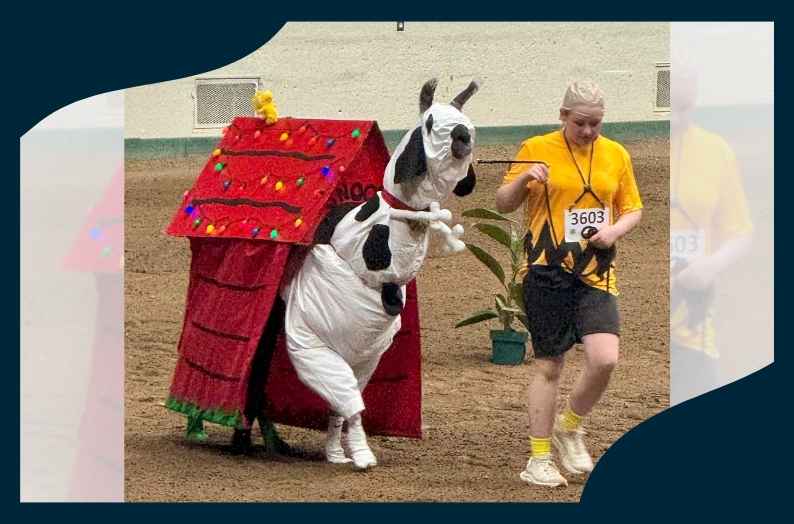
What do accessibility, a llama dressed as Snoopy, and a few disco balls have in common?
More than you might think. Ablr’s new Accessibility Manager, Sharyn Morrow, recently attended the Minnesota State Fair with two things on the agenda: experiencing the Fair through an accessibility lens and, just as importantly, catching the 4-H Llama-Alpaca Costume Contest.
Meet Sharyn
Sharyn brings more than 10 years of accessibility experience to Ablr, along with a deep commitment to disability inclusion and creating meaningful opportunities for people with disabilities.
Throughout a career in accessibility, Sharyn has helped organizations make digital experiences more accessible while developing strong teams and supporting the people doing the work. That combination of accessibility expertise, leadership, and people-first thinking makes Sharyn a natural fit for Ablr. So, naturally, a trip to the Minnesota State Fair included an accessibility lens. And we’re glad it did.
Accessibility at the Minnesota State Fair
A state fair can be an accessibility challenge: crowds, noise, signs, performances, animals, rides, food stands, and thousands of people moving in every direction. The Minnesota State Fair has put considerable thought into making that experience more accessible.
For visitors who are blind or have low vision, the Fair offers human guide services, free Aira mobile app visual assistance, audio description, and materials in large print and Braille.
ASL interpretation and captioning is provided for the free shows, with additional interpretation available on demand.
For sensory-sensitive visitors, multiple sensory-friendly spaces provide places to recharge away from the intensity of the Fair. A sensory-friendly guide also helps visitors choose events and times that may be less overwhelming.
Visitors with mobility disabilities have access to accessible restrooms as well as adult changing stations equipped with lifts.
Taken together, these features demonstrate something important: accessibility isn’t one solution for one group of people. It is anticipating different barriers and giving people more ways to participate. And sometimes what you want to participate in is a llama costume show.
Yes, We Need to Talk About the Llamas
Accessibility wasn’t the only reason for Sharyn’s trip to the Fair. The 4-H Llama-Alpaca Costume Contest was also on the must-see list. One young person dressed as Charlie Brown while their llama became Snoopy, complete with Snoopy’s doghouse on its back. Another 4-H participant appeared as Velma, accompanied by a Scooby-Doo llama wearing the Mystery Machine. Then came a Mamma Mia-inspired duo, complete with balloons resembling disco balls.
It’s joyful, wonderfully ridiculous, and also a reminder of why accessibility matters in the first place.
Accessibility shouldn’t just help someone get through the gate. It should help them experience what is on the other side.
That’s What Inclusion Makes Possible
We often talk about accessibility in terms of standards, guidelines, testing, and compliance. Those things matter. But ultimately, accessibility is about people.
It’s about being able to go to the show. Navigate the crowd. Find the information you need. Take a break when you need one. Participate in the experience rather than work around barriers throughout it.
That lesson extends far beyond the Minnesota State Fair. It applies to the websites we build, the workplaces we create, the conferences we host, and the communities we want everyone to be part of.
With a little planning and good intentions, events can be made accessible and truly enjoyable for everyone.