
 Risk Free Assessment

Access Granted Episode 33 Transcript
Mike: Welcome to Access Granted, powered by Ablr. I’m your host, Mike Iannelli, and today I’m joined by Alan Hejl (pronounced ‘Hale’), founder and lead accessibility consultant at Spark Access. Alan’s work sits at the intersection of accessibility, disability inclusion, and mobility. After spending about 15 years in the automotive industry working with companies like Ford and General Motors on connectivity, autonomous vehicles, and starting the auto industry’s first accessibility department at General Motors, Alan’s personal and professional experience opened his eyes to the many barriers that people with disabilities can face when it comes to transportation.
Today, through Spark Access, Alan is working to help make mobility more inclusive for people with both visible and hidden disabilities, while also advocating for accessibility through his work with organizations in his community.
In this episode, we’ll talk about Alan’s journey into accessibility, what the mobility industry often gets wrong, the future of accessible transportation, autonomous vehicles, disability inclusion, and what it takes to move from simply identifying barriers to creating meaningful change. For those listening, give me just a little background about you, what you’ve been doing. Just share with the audience what you’re doing now and introduce yourself for us.
Alan: Thanks again for having me today, Mike. I really appreciate it, and always jump at the opportunity to reconnect. But yeah, my name’s Alan Hejl. I lead Spark Access, which is my consultancy to really create a sense of belonging in the mobility industry for people with disabilities.
And mobility, it can mean a lot of different things to a lot of different people, but really in the context of new modes of transportation and how we move throughout our worlds. I primarily focus on autonomous vehicles, zero emission transportation, like electric vehicles, and electric vehicle infrastructure like charging, and how we fit all these new things into our cities and communities.
The underlying pillar between all of those is you need people with disabilities in those spaces to be the experts on accessibility and to understand that experience. And all that’s built on just my background of close to 15 years in the automotive industry, where I was working on things at Ford for autonomous vehicles, and then hopped over to General Motors. I had started the auto industry’s first accessibility department.
Mike: That’s fantastic!
Alan: Yeah, I started to see those systems and where change can happen.
Mike: Before we dive deeper though too, just I’d like to hear about your story. What sort of motivated you? What was a moment in time where you said, “I need to do different. I need to do better. I wanna help.”
Alan: Where my real route to advocacy came from, my wife, who you’ve gotten to meet her as well
Mike: Yeah.
Alan: At I think at that same disability event
Mike: Yeah. Yes, I did. She’s great.
Alan: But my wife has a spinal cord injury and is a manual chair user. And she’s at Ford Motor Company still doing incredible things. But through traveling the world together with her, I think we’ve been to about 18 different countries.
Mike: Wow.
Alan: We do adaptive scuba diving together and some other fun things. It means we’ve done every mode of transportation out there. We’ve encountered and every form of bias and struggle that wheelchair users have in travel.
Mike: So I’m interested in the automotive to accessibility. So did you start in automotive as just automotive as an engineer, right? So then you sort of evolve into accessibility, right?
Alan: Just through, I think, building my own understanding of advocacy and from our experiences, getting more involved in the community of showing up to local city council meetings to talk about sidewalks and making those more accessible to getting involved with statewide volunteering around different accessibility or disability initiatives. I started to build into an advocate in that sense. And then at the same time, my corporate career took off at Ford. My background is actually in network engineering.
Mike: So you’re an IT guy?
Alan: A little bit, yeah. Ford got me started in 2010 of doing, like, all the back end of international video conferencing, but then that quickly turned into my real passion was bringing internet to vehicles, and 2010 is right when that started happening across a lot of automakers. And so that just put me in kind of the advanced technology track at Ford Motor Company. We’re working on how do we bring internet service to vehicles, working with cellular carriers, creating a special automotive modem for the car that could do all these amazing things with connected vehicles.
That led to me being a 5G expert when 5G was still very early an unknown technology. And then that led to me working on autonomous vehicles. And for autonomous vehicles, these are vehicles that are operating as a service for the most part, and have an obligation to serve all people, including people with disabilities, because they’re often integrating with maybe public transportation corridors. They’re integrating with different systems in cities and communities.
And what I saw was people didn’t understand disability. They didn’t understand how people with disabilities move through our communities, and rarely had expertise in the room talking about accessibility. And so I just saw that opportunity that they need to hear more stories.
They need to connect with the community a lot more.
As a network engineer doing full-time day job things, I started putting together a few lunch and learns, started getting a little more involved in bringing in experts or helping push the needle as much as I could of just an internal advocate within the company.
Mike: So one, let me just validate. I’m very interested in the industry because you think oftentimes about autonomous vehicles, and you think Tesla, you think the Google machines rolling around. You see these new little widgets all around town driving people around. Mm-hmm.
But even then, you see the value of the transportation, but I never even thought about the accessibility of it. Like, how does it work, and how are things really progressing in your opinion, moving on from the, “Hey, this thing can stay within the barriers and auto brake.” versus, “Hey, we’ve got autonomous vehicles driving around town, picking people up, bringing them to work, taking them places?”
Alan: Yeah, that’s a really great and thoughtful question. Maybe to preface it with another small advocacy story that it’s another building block that led to me understanding the future of mobility was to go back to a rideshare experience we had, and this was maybe back in, I think it was 2015 or so.
Uber and Lyft still hadn’t hit full efficiency in the metro Detroit area. But my wife and I, we were in the Bay Area visiting some friends, and it was a classic drizzly day in the Bay Area, and we were on the side of the road and wet and waiting for an Uber to come pick us up. Our driver comes up and then just speeds up and keeps going.
And then a second one pulled up, rolled down their window, and said that the wheelchair couldn’t get in his vehicle because it would get his car dirty. Good luck getting another driver. And so he declined the ride and re-matched us again, and then we had another drive by for that third ride.
We devised a tactic where my wife hid around the corner. And then I was just the guy with the bags waiting for the Uber to come pick us up, and then as soon as he pulled up, I threw all of our bags in, and then she came out, and luckily this driver was also really nice, so we probably didn’t have to ambush driver number four.
And everybody was saying rideshares, the way of the future, taxis are dead, but then we found out who is this for? Is it including everybody in this vision of it’s a multi-billion dollar industry, it’s getting all this venture capital investment, yet they excluded people with disabilities from the start, and even still today struggle with its policies of anyone who uses a service dog.
Almost everybody has had an experience of being denied a ride when they’re using a service dog. I think for a lot of folks who are wheelchair users, it maybe has gotten a little better. There is training that drivers are given these days.
Mike: Being married to Emily, being a wheelchair user, how does that make you feel when you see these types of activities happening, where Uber riders are blowing by, where no one has the time of day to help someone, where it’s always an excuse, and yet you’re sitting in the rain, just trying to get someplace?
Alan: Great question, and that’s a deep question, too. To see that so blatantly left out of the business model and the equation, it hurts, and it feels like, I think from the disabled perspective, it feels like that business model is built on the backs of people with disabilities in some sense.
It’s designed to exclude you by default, and it takes advocacy and a constant fight to have it include you. I think from the third-party advocate perspective as a partner to somebody who experiences that, it just makes it, I think, twice as hard sometimes. My wife has two degrees from MIT. She’s got her MBA from University of Michigan Law School of Business. She’s brilliant.
But even after a decade, the rideshare industry still has a long way to go. The promise of autonomous vehicles is independence, and it’s being able to hop in a vehicle without personal bias of a human driver or a human operator. But it does then put us into what are we doing to remove the barriers in the systems we’re creating, and then what was human bias now has the potential to become a system bias.
There’s a lot more ways to think of accountability and system bias than we ever did with human bias. To I think leave on like an optimistic note. There’s this promise of freedom but it still leaves us with the question of who’s going to build it. Without people with disabilities at the helm across the autonomous vehicle industry, that future will never come to be fully realized. So that’s what I do a lot of my consulting in for the autonomous vehicle industry is ask that question at every turn of as someone who was able to build a team at General Motors, I haven’t seen those teams where it’s both user experience and customer experience engineers with product engineers who maybe have marketing specialists and somebody who knows how to make an accessible product happen. It’s not necessarily the realm of public policy, which we see a lot of today.
Mike: It also leads me back to this, how safe are these things? You do this every day, so are we in a spot now where we’re, like, legitimately in a safe environment where we’re gonna be seeing these things rolling out like the Bird scooters and everything else across the board? Is this gonna be taking over America right now?
Alan: In general, there is an increased element of safety in terms of driving, and for anyone who’s ridden in an autonomous vehicle, they often drive fairly conservatively. They come to very complete stops at stop signs. And again, to go back to the promise of autonomous vehicles is not only the independence, but also the increased safety.
Mike: If we start including all people and providing services and support for all people, leveling the playing field for all people, there’s clearly profit in all this for that. Why, in your opinion, is this so complicated? How long is this gonna be a topic of conversation where we’re still excluding people, we’re still not considering mobility issues, we’re still not considering people with visual impairments or accessibility dogs? What do we need to do, my friend, to change this?
Alan: This is where there’s a lot of positives to regulation, and there’s a lot of positives for setting up the guardrails and expectations of things, and I think we’re at a moment right now where both local and state regulation is needed for the service elements. I think there’s a lot being done across the last three federal administration.
There’s a lot of barriers when it comes to automotive regulation and what that could mean for autonomous vehicles. To add the service requirements is something that’s often done at the city level. New York City’s a great example where Manhattan as a service domain, they’ve created 100% parity for wheelchair accessible vehicles and ride share, and it’s due to a lot of public/private partnerships. It’s due to a lot of transparency in the models of how that happens. But ultimately, it’s due to regulation.
Mike: And I’m hoping that we see a change, and obviously with technology, with AI, with all this stuff that we’re seeing, are you confident that we’re gonna see some radical change that all of us in this community are hoping to see?
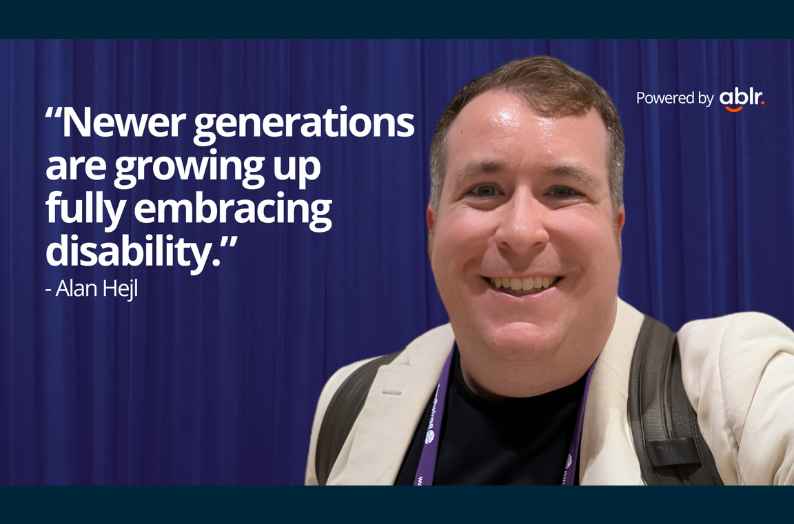
Alan: A point of optimism I have is it’s often easier than ever to find your community, and my favorite Gen Z phrase is “touch grass.” And getting people out of their digital spaces out into the world, and finding ways to share those stories. I think there’s a lot of examples where storytelling is easier than ever, thanks to different social media platforms, and thanks to just different layers of transparency that folks bring to those spaces. I think the point of optimism always is newer generations are growing up fully embracing disability.
Mike: Agreed.
Alan: And we’re seeing it with, I think it was just talked about at the Disability:IN Conference, where it’s more than 60% of Gen Z employees who are coming to the workforce identify with neurodiversity. And I think everybody has had the shared experience through COVID of dealing with deeper depression and anxiety than previous generations, and much more openness to embrace that and make that part of who we are instead of just like my grandfather did, drink a bowl set and fall asleep in the corner was his form of therapy.
I think we’re just in a new generational shift where folks are a little, just a lot more aware, a lot more compassionate. And even with all the negativity out there, at the end of the day, in our communities, the spirit’s growing a lot more. And I know you guys do amazing things in North Carolina.
In Detroit, we’ve got a newer nonprofit here, Detroit Disability Power, that’s doing amazing work to build this new pipeline in our community, and we’re seeing the progress happen in front of us. And so I think across the US that’s happening just more and more, where maybe the system as a whole isn’t radically changing, but all the seeds that feed it are. And so I do have a lot of hope that in the next decade or two, we’re going to see the pendulum shift pretty quickly.
Mike: John, who was our partner for six years, he traveled a lot overseas, and I remember him telling about Japan and just how Japan was just so accessible. Not only was it clean and the people were nice, but it was just so accessible. The curb heights were right. They had the, I don’t know all the terminology, which you probably do know, but..
Alan: Yeah, the Tenji blocks are the pathfinding system on all the sidewalks. Yeah.
Mike: Yeah. Is that because they thought of this in advance? Are we, like, dealing with a Jenga game in the United States, where everything has to be reestablished?
Alan: I’m glad you brought up international experience and an example like Japan, where a lot of the rest of the world are very service-oriented cultures. And that comes with an understanding of no matter who walks through that door, I am going to treat them as though they have walked through that door 1,000 times.
The ADA doesn’t necessarily ask the question of how can I best serve people with disabilities when they’re in my space? And that’s a big difference between other countries of a lot of their civil rights are formed around that question of you maybe are in a building built in the 1200s, as an example and..
Mike: Understood.
Alan: you might not be able to make it readily accessible. But often just through prioritizing that answer of how do we equitably treat people with disabilities, they will make it accessible, and they won’t rely on the excuse that, “Oh, it’s a historic building.” They rely on, “It is our moral obligation if we wanna continue operating, that we have to serve people with disabilities, and they’re a part of our community.”
Mike: Who are the people, in your opinion, that are doing it, that we can follow?
Alan: Great question. I’ll come back to the person and the people to follow. But I think starting with that fundamental of, like, why people get left out, and I think a key phrase you’ll often hear in this space and other spaces is, “What matters gets measured.”
That question in itself is, like, a good one to challenge systems with of are you measuring how people with disabilities are interacting with whatever you’re developing? Are you measuring, like, how many people with disabilities are at your company? Are you measuring how many people with disabilities are in your community?
But when I was at General Motors, we had that problem of, like, just going through a lot of the stories from employees and through the employee resource group as our hub of advocacy. We learned just, like, over 30 years of history at General Motors, accessibility had been tried and tried again in different ways, and a key barrier was it could never connect to a business case that was compelling enough to make it out of ideation and into design and into production.
And so we started looking at, like, why is that? And we had some great allies in our market research team, and we found that disability wasn’t a recognized demographic of customers, and this is the behemoth of millions of customers. How long ago was this? This was 2020. So yeah, so disability wasn’t a recognized demographic for an automaker, and that’s true still, I think, for some automakers.
But finding ways to start tackling that and cracking that, where a lot of times there’s stigma around disability of folks who are ignorant to it, who don’t understand disability studies. They might just hear the word disability and say, “Well, that’s HIPAA information. We can’t collect that about anybody.” And that was the case in some of those examples. Flash forward, we got disability as a recognized demographic.
And after only a couple years, we found that more than a fifth of drivers identified with disability. And the amount of progress that’s been made of because of that momentum, because of that recognition, is why we have companies like Microsoft with the chief accessibility officer. Why we have these executive positions. Salesforce is another one.
Mike: That’s right.
Alan: It’s growing across the tech world. It’s growing across other industries. And it’s often in response to, again, that question of, what are we doing for customers with disabilities? Or what are we doing for employees with disabilities?
There’s a lot of different ways you can answer that question, but ultimately having somebody responsible for answering that question and resourced to answer that question becomes the fundamental.
And I think that goes to the people to follow, and I think the influencers in this space. I see it as a blend of both people who are at the top, both government advocates who are working. I think Maria Town with the American Association of People with Disabilities is a really great hero of mine who AAPD tackles everything with a cross-disability lens that tries to strive for nobody being left behind.
And they tackle the hard issues too of access to housing, access to voting, access to healthcare, you name it. And then I think from the corporate world are some of those leaders who take on the mantle of an executive leadership position in disability. It changes time to time.
So like Jenny Lay-Flurrie used to be the chief accessibility officer at Microsoft, now it’s Neil Barnett. But both brilliant in their own rights, and then there’s probably a dozen other names to follow in that track. But then a lot of the up-and-coming influencers and folks who are on social media and are mastering storytelling with these new modes of communication, those are starting to shape our society. And a lot of those stories that are told from the lens of a phone camera out in the wild, those quickly turn into political advocacy that can lead to change and can lead to impact in our communities.
Mike: I was thinking too, just one of the points I wanna make is, and I think you would agree with this, but usability and accessibility, right, it helps every human being. Would you agree with that statement?
Alan: Yeah, absolutely.
Mike: And so you jumped into Spark Access, which is perfect, ’cause you’ve identified gaps, right? You clearly as someone who’s worked in some great organizations, have done some great work, your personal lived experiences, everything, you saw things that weren’t happening, right? You said, “I gotta do better, and I wanna spark this.”
And so you talked a little bit about some of the things in the mobility industry that we’re lacking. Is there anything else you can share? And then also I wanna kinda hear really about what is the core of what you’re doing? I know you touched on it a minute ago, but how are you helping organizations every day?
Alan: My core philosophy with Spark Access is to lead this technical innovation, or to at least inspire this technical innovation for mobility, but do it with the disability community side by side, and do it with an industry that can welcome the disability community to work with it.
And in all these new modes of transportation, whether it’s EV charging, whether it’s autonomous vehicles, whether it’s what’s coming next for cities. They’re all in the scarcity mindset, and for the most part are driven by startups, are led by technical experts in AI algorithms for driving, and the EV charging industry is led by electrical engineers who are there to create something that won’t explode.
The notion across all of these, though, is rarely is human-centered design at the center, and rarely is that customer experience at the center when these are customer-facing products and these are customer-driven. There’s really hard days, and there’s days where you celebrate, but that’s all kinda part of disability justice too at the end of the day. It’s maintaining the history and the hard-fought battles, and then setting a future for the vision for the next generation to chase as well.
Places like North Carolina are great examples where your business community does come together, and they do talk about disability, and it’s thanks to folks like John, it’s thanks to folks like you, it’s thanks to folks like Beth with Disability:IN North Carolina. There are a lot of different folks who do that convening, and so I’ve been just learning and seeing what building blocks we have in Michigan, which it’s one of the largest economies for the Great Lakes states auto industry is one of the largest industries in the world.
It’s a huge opportunity to have those conversations, and where all these companies in our region are struggling with the same issues for how to hire and retain people with disabilities. That at the end of the day, that’s a reason we don’t have accessible vehicles, is there’s not enough people with disabilities in the auto industry who have the confidence to raise their hands and to have a voice to explain and change those barriers.
And so ultimately, a big picture, that’s the long-term goal I have, is simply convening folks and starting to kick off the conversations and keep those relationships healthy and positive and find ways to tackle those solutions together.
Mike: When I think about the word compliance, that word is a difficult word for me. Do you agree with that word?
Alan: Absolutely! My friend Randall Duchesneau, who used to be at the US Access Board, so I feel I can really talk to compliance. The US Access Board, they’re the body that interprets the ADA for different businesses, and they create a line of compliance. So Randall, whenever I’ve seen him talk, he always will usually open with, “So you’ve met the ADA, great. That means you’ve gotten a D+. You can pat yourself on the back for that.”
Mike: Yeah.
Alan: It usually means you’re doing the absolute bare minimum.
Mike: Exactly.
Alan: And again, to go back, it doesn’t answer that question of how are we treating people with disabilities in our space? To raise again to optimism and I got to see this a lot
Mike: Bring it.
Alan: with General Motors, was the new talent coming in, they do get it. They worked on a school project in high school or college that focused on disability. They have watched their grandmother age in place and struggle with the house. They’ve had this intergenerational perspective, and it is being taught in schools.
And I think the challenge is what do we do when these bright minds with all these ideas and optimism of how to make a better system after having that experience in schools, what happens when they enter the corporate world? Do you crush those ideas? Or do you see it as an opportunity?
Mike: It’s not just, “Oh, there are other people that are different than you, and this is what they do.” versus, “Hey, y’all, this inclusion matters. This is why it matters. It brings us together as people. It helps us determine problems that we can solve together.” I don’t know if I can say that that’s happening in public school system, let alone everything else that’s failing in the public school system.
Alan: Yeah.
Mike: Are we really educating people correctly?
Alan: It’s not, like, a static checkbox either. Again, like, it’s a constant evolution where, like, that platform and theme has to maintain and evolve in those systems. And I see it. I have a 16-month-old daughter, and we’re, like, going to the library every week and get new books. And just like, some of the kids books out there that are there they really focus on diverse representation, different cultures, different gender identities.
Mike: But you’re driving that. You’re a parent that cares and is advocating.
Alan: Yeah, I’m picking out those books.
Mike: Yes, exactly, which is beautiful. You’re obviously, based on our private discussions, I love what you’re doing with the yard and the kid and the family. We’re gonna have to do another round two and have you and Emily here and do it in person.
I love what you’re doing, and it’s super cool, too, let’s be honest. Autonomous vehicles. How cool is that, right? But you’re doing it with intentionality. You’re doing it with purpose. You’re doing it lived experiences, and you are seeing progress. You’ve said probably five times today, “Let’s put an optimistic lens on this.” And I think that’s probably the one thing I’m gonna take away from this, is we are making progress.
Alan: To unpack that, too, is I think it’s acknowledging, and there’s a lot of health in having skepticism towards, like, new technologies. There’s a lot of health in challenging, like, is this truly accessible? And I think I do that a lot, and maybe undersold, how much I do of, like, rabble-rousing of, “Hey, like, this EV charger just got installed a mile from my house, and it’s not accessible.”
I know the layers of like state funding that helped make that happen, and so I’m like knocking on the doors of folks I know within the state government. And I’m like, “Hey, this happened literally next to me, and I’m the national expert on accessible EV charging.” And I cannot tell you how frustrating that is. I think pairing the frustrations of today with the vision and maintaining a vision that this is possible, this is achievable.
Mm-hmm.
I think there’s nothing readily that’s a barrier to achieving that vision. That’s just how I always operate, and you just need all those right building blocks to get there.
Mike: This has been really a lovely conversation. I’m really appreciative of what you do. We haven’t had a ton of time together. I’d like to spend more time with you. I’d like to find ways that maybe we can help each other together, sort of rising tides.
What you’re doing matters, and your leadership in this community matters, and I’m very grateful that you joined us today. I’m hopeful that Spark Access continues to do great work, you continue to change the game. Because of all the big guys that are out there, it’s the little guys that are really making the difference. So I appreciate you being here, my friend.
Alan: Yeah, and thank you. And I actually just got an email yesterday. I might be in North Carolina in December.
Mike: Sweet.
Alan: Yeah, there’s going to be an autonomous vehicle day in Raleigh at the Capitol on, I think it’s December 8th.
Mike: You let me know, and I’ll find a way to be there. And we’ll hang out. We can also do some content. We get to go out to eat. We can do whatever. But catch up. I’d love to see you in December. There’s a lot of people out there that are not on board with the reality of life and humanity. And we and certain others have to make sure that we continue to keep them in line. And so it’s not an easy job, but I wanna get you this stuff rocking.
Alan: Yeah, thanks, Mike.
Mike: And please give Emily my best. I’d love to have you both on again to talk about this experience, but I also wanna find ways that we might be able to support each other and do something really cool together. So if anything comes up, please let me know at any time. I’d love to catch up with you again.
Alan: Yeah. Sounds great, Mike.
Mike: All right, my brother. Thank you so much. Awesome job! Thanks so much for tuning into this conversation with Alan Hejl today on Access Granted.
Alan’s story is a powerful example of how accessibility can move from something we understand professionally to something that becomes deeply personal. As Alan reminded us, creating a more accessible future isn’t just about removing barriers that appear. It’s about involving people with disabilities from the very beginning and designing products, services, and systems with a broader range of people in mind.
A huge thank you to Alan for sharing his experience and perspective and for the work he continues to do through Spark Access and within his community.
And thank you to everyone listening for continuing to be part of these conversations. Keep asking questions, keep challenging barriers, and keep working towards a world where accessibility is built in from the start. We’ll see you next time on Access Granted!