
 Risk Free Assessment
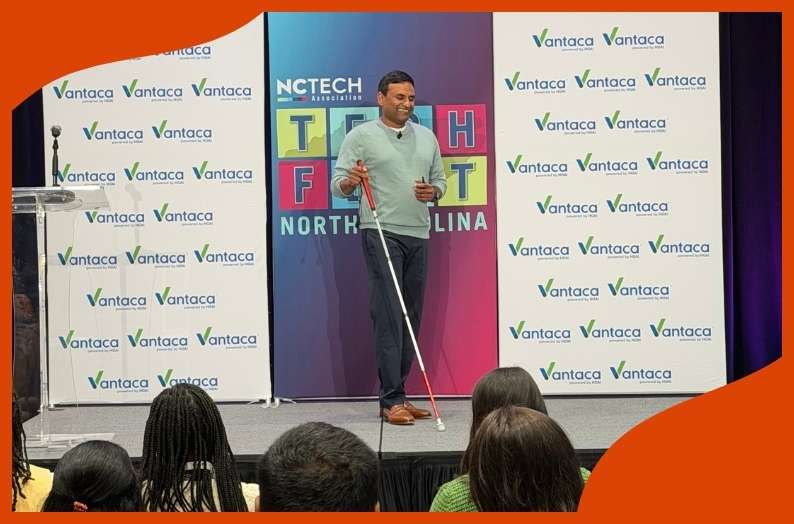
Last week, the Ablr team had the opportunity to participate in NC Tech’s inaugural TechFest North Carolina event.
When we were invited to host an “Empathy Lab” focused on digital accessibility, our team immediately began brainstorming what that could look like. Could we create an interactive experience that helped attendees better understand accessibility barriers?
But the more we talked through it, the more we wrestled with an important question – Can accessibility awareness really be built through simulation?
Too often, “empathy exercises” unintentionally oversimplify the lived experiences of people with disabilities. They can reduce complex, everyday realities into a brief activity that participants walk away from believing they fully understand.
We knew we wanted to do something different.
Instead of creating an empathy lab, we created what we called a “Curiosity Lab.”
Our goal wasn’t to simulate disability, but it was to spark curiosity.
We designed a three-zone experience that invited participants to engage with accessibility in a way that was interactive, practical, and rooted in reflection.
We started with quick prompts and interactive questions designed to challenge assumptions about accessibility and technology.
This would give people an easy entry point into the conversation and help them begin connecting accessibility to their own work.
The centerpiece of the booth featured side-by-side examples of accessible and inaccessible digital experiences.
Attendees would explore questions like:
- What does a screen reader announce when link text is vague?
- What information is lost when images are missing alt text?
- How do small design decisions create either access or barriers?
For many, this would be the “aha” moment (which we’re always looking for!)
This is where people would quickly realize that accessibility isn’t about massive overhauls or complex compliance checklists. And often, it comes down to thoughtful decisions made early in the design process.
We wanted participants to consider one simple question – “What is one change you could make to improve accessibility in your work?”
This would shift the conversation from awareness to action. Because accessibility doesn’t improve through understanding alone. It improves through intentional choices.
When the doors opened during the first moments of the event, our team quickly realized we could barely guide people through the experience fast enough! Not because the activities were too complicated, but rather people wanted to talk!
They wanted to ask questions, they wanted to share ideas, they wanted to better understand how accessibility barriers show up in the real world – and what they could do differently! And we loved it all!
And that’s when we were reminded of something important. Sometimes the most meaningful accessibility work doesn’t happen through elaborate exercises, but rather it happens through conversation. Real understanding is built when people engage with one another, ask thoughtful questions, and stay curious enough to listen!
We’re incredibly grateful to NC Tech for creating space for these conversations and for inviting Ablr to be part of this inaugural event! I’m especially grateful for the opportunity to not only exhibit the work we do, but also to share a broader message about accessibility and innovation. During the event, I had the chance to share my thoughts on the main stage about how I believe the Future of Tech Is Human Access (the one talk not about AI!)
I truly believe that as technology continues to evolve, accessibility cannot be treated as an afterthought. The future of tech will not be defined solely by what we build, but it will be defined by who we build it for! (I got a shameless plug here – if you want to read more about my talk? I’ll be writing about it in my next personal newsletter, so sign up at www.JohnGSamuel.com)
So, as I wrap up, remember to stay curious, ask questions, and start the conversation! Want to get started with that? Then reach out to our team, we would love to hear from you!