
 Risk Free Assessment


Access Granted Episode 32 Transcript
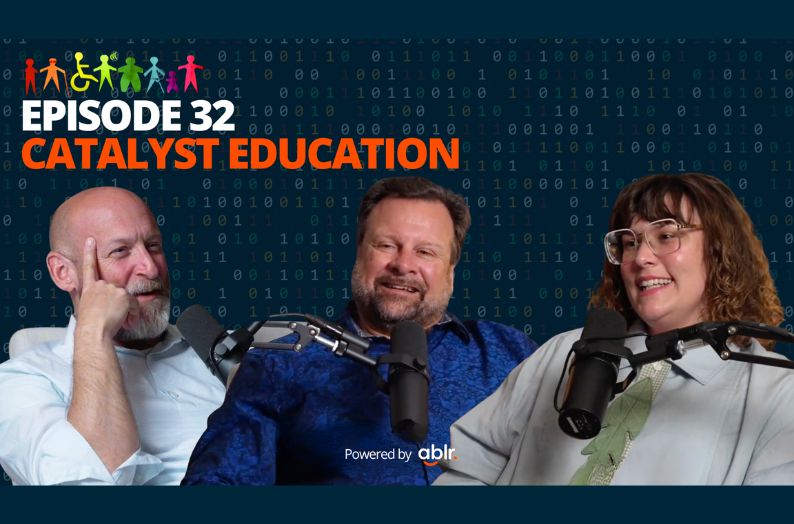
Mike: Welcome to Access Granted Powered by Ablr. I’m your host, Mike Iannelli, and today I’m joined by Jamie Caras, CEO of Catalyst Education, and Mandy Dark, Product Owner. Catalyst is helping shape better digital learning experiences in higher education with a strong focus on STEM, student success, and accessibility.
In this episode we’ll talk about Jamie’s journey through education and EdTech, Mandy’s work improving the student experience, and how Catalyst has partnered with Ablr to make accessibility a true priority. We will also explore what accessibility looks like in today’s EdTech landscape and why it matters more than ever.
Well, thank you all for being here. I know that Mandy, you just drove down from Richmond, we just talked about that briefly and you made it and you’re here and I’m very grateful that you’re here.
Mandy: It’s a pretty good drive.
Mike: And you also have that cool thing on your shirt, which you can pimp that out. I think that’s super cool. And James, we’ll call Jamie. I would like you to introduce yourselves first. So, I’m gonna say, James, it’s hard. I respect you. That’s what it is.
James: James, Jamie, works either way.
Mike: Jamie, it’s just hard. We’ll have to get to know each other for the Jamie call. But no, Jamie gimme a little bit of your history, ’cause you’re the CEO of this great company that we work with, Catalyst EDU. You do some amazing work, but your background is also amazing too. So introduce yourself. Tell us a little about yourself.
James: Yeah, I’m the currently the CEO of Catalyst Education. I’m a serial EdTech entrepreneur, so I’ve been building software and media for students to use to learn primarily science, but also in social sciences and business.
And this is my third company, Catalyst Education. Prior to that, I founded Sapling Learning and then a company called Science Technologies. And I’ve always been interested in teaching and learning. Got into this because of the students’ struggles that I saw while teaching at the University of Texas.
Mike: Wow. So this is a personal thing for you that shaped you along the way.
James: Absolutely.
Mike: And started in college. Is that kind of where you started to figure out, this is something I see a gap and I want to create an opportunity here.
James: Yeah, actually I got started down this path. I was doing computational chemistry research at University of California Santa Barbara, and I also had a job at the chemistry computer center, which basically my job was to tear the little perforated side things off of the dot matrix print jobs when people are printing out their lab reports. But my..
Mike: I remember those, They do the [computer noises]. Yeah. Those are great.
James: Yes. But my boss is an interesting guy. He said, “Look, you can’t just sit around and do nothing.” And he said, “If you’re not helping students use the computers, then you need to produce something that’s useful for the university.” So I started learning how to use technologies such as HyperCard. Now I’m dating myself.
Mike: Well, you’re more than dating yourself. I have no idea what you’re even talking about. Alright, so what is HyperCard before we get into your introduction?
James: HyperCard was this product that Apple developed. It was really one of the first non programmer friendly development languages that you could utilize to build basically stacks of cards. Think about of them as flashcards. But they could be interactive and you could build logic into them. So I started building actually games for students to learn chemistry. One of them was actually like a Dungeon Crawler, where a monster would jump out, ask you a chemistry question, if you got it wrong, it would hit you and do some damage to you. And if you got the question right, you would hit it and then you could make progress.
Mike: You built those?
James: Yeah.
Mike: That’s wild.
James: At UCSB, the chemistry department was one of the first departments
to provide a whole lab filled with NeXT computers. Now, not a lot of people know this, but NeXT computers were the first computer that could run a web browser. So the NCSA Mosaic Web Browser, it was called Worldwide Web, I think was the name of the browser. It was the first browser for the internet, only ran on NeXT boxes.
Mike: This is early nineties, right?
James: Even late eighties, I think.
Mike: Late eighties. Okay. Wow.
James: I was doing a lot of computational chemistry, so I was using the internet when only scientists were using the internet, and I was submitting jobs, basically computational chemistry and molecular modeling jobs to the EPA supercomputer in Las Vegas and was using the internet to do that and then communicate with researchers over email.
But when the NeXT boxes came, I got turned onto this whole idea that you could put content on the web for anyone to view and browse. This predates kind of the age of the internet now, where people are kind of self-promoting or doing things. So I thought, well, I’ll just write a bunch of chemistry content, put it on some websites.
And I think I was the 32nd person to have a web storage space on the servers at UCSB.
Mike: Wow.
James: And so I started writing chemistry content and putting it on the web for people to use to learn. And so that’s kind of how I got into the combination of teaching, learning, and technology.
Mike: Yeah.
James: And one thing that I’ve always been enticed by is this notion of delivering education and impact at scale. And so like right now at my company, Catalyst Education, we service about a quarter million students a year. My prior company was over half a million students a year. When I taught biochemistry, I taught these huge lecture courses. I taught about 500 students, biochemistry majors at UT Austin, but I could do that every single semester for my entire life and not have the same educational impact that our company has.
Mike: Mm-hmm.
James: Over a single semester. And so..
Mike: Wow.
James: that’s how I got into using technology to deliver instructional gains, educational impact, but over hundreds of thousands of students as opposed to the direct educational experiences that you would give as a lecturer or professor. I kind of still miss that direct personal connection.
Mike: Yeah, I was gonna say that must be difficult.
James: But delivering it at scale is something that is really appealing to me.
Mike: Well, your impact is amazing. 750,000 students, let alone everyone you taught, so at the end of days you can look back and say, I made an impact. It changed a lot of people’s lives.
Mandy: The coolest thing is that people who have used our platform as students, who are starting to become graduate TAs and graduate TAs that have used our platform that are starting to become instructors.
Mike: That’s wild. So they of went through the entire life cycle of the program. That’s incredible. Alright, so you just talked Mandy.
Mandy: Yes.
Mike: So let’s say hello, introduce yourself.
Mandy: Hello. I am Product Owner at Catalyst Education. I specialize in our lab report part of our platform. It’s effectively an interactive form, but we do a lot of different things with that interactive form. And so it’s complex enough that it has its own Product Owner.
Before I was the Product Owner, I actually developed some of the lab report content, so I am also a chemist by training. I did undergrad at UT Arlington and then an organic chemistry master’s at UC Irvine. And then went into teaching and then went kind of dabbling in some freelance content creation. Actually did some at Sapling, not while Jamie was there. And then ended up finding my way to Catalyst.
Mike: So you worked at Sapling?
Mandy: Yeah.
Mike: And you didn’t know Jamie, and then you guys now working?
Mandy: It was after he had left Sapling actually.
James: Yes, I sold Sapling Learning to one of the Big Five publishers, McMillan, and it went on to become Achieve, which is now their teaching and learning platform. And so..
Mike: That’s amazing.
James: it actually has gone on to have a whole life. And serve even now, millions of students across many disciplines in the hands of McMillan, which is something I’m very proud of.
Mike: Yeah, you should be. Absolutely.
James: Sometimes entrepreneurs, you sell your company and eventually they kill your product, or the whole company goes kind of by the wayside. That’s not the case. As a matter of fact, to McMillan almost recentered a lot of their business in Austin, Texas.
Mike: I never understood that. Why buy a company and then dismantle it and destroy it other than competitive reasons and maybe some IP, but I get that. But like, I can’t stand when I see an organization, a great organization, big or small, could be a restaurant, could be a huge company, and they get acquired and the whole vision of the company is sort of eliminated instead of actually carried on.
So it’s like, why do you buy a company to begin with? You love the company. You should embrace the company. Like what McMillan has done is taken something amazing and took it to an entirely different level. And then obviously it was very beneficial for you, but they could have destroyed it. And instead you get to see your dream that you’ve built now functioning at a higher level with a different team behind it, evolution. You gotta be super proud of that.
James: I am, and I’m fortunate enough to be in an industry where some of the larger strategics who might acquire businesses such as, you know, Sapling Learning, as they are shifting from print publishing to more digital learning,
they need a lot of help. They historically have not been innovators themselves, and they’ve had a lot of tried and failed attempts at digital technology, but they have done a good job of acquiring EdTech companies and making them core and key to their strategies moving forward. One example is WebAssign from NC State in, Raleigh.
Mike: You’re wearing duke blue though, so..
James: That homework platform, one of the original, if not the original homework platforms is still used by Cengage.
Mike: That’s wild.
James: Those companies, they’re strategic about their acquisitions and because they really needed solutions. They’ve actually thrived, but it’s very unusual. I agree with you. It’s very unusual for entrepreneurs to sell their company and have that live on for very much longer.
Mike: Yeah, that’s gonna be so much more gratifying. I mean, all the other benefits that come with an acquisition are gratifying. But there’s also some grieving that probably comes with it as well.
James: Oh yeah, there’s a little bit of, you know, watching your baby being torn apart by hyenas. But, largely it’s been a good thing, and a lot of my former employees still work there and are very happy there.
Mandy: Former Sapling people are also at Catalyst Education.
James: Yes.
Mike: So how many employees do you have a Catalyst?
James: I think we hired someone just yesterday or something.
Mandy: We’re over 50 now.
James: Yeah, it’s like 60, mid sixties.
Mandy: I started at Catalyst in 2020, and I think there were less than 15 people.
James: Yes.
Mike: You’re the OG.
Mandy: Yeah, I was doing the freelance content authoring and teaching at Dallas College, and the content authoring kind of dried up with the pandemic, and so I was kind of like looking for somewhere else to do that. And someone pointed me to Jamie. I reached out, mentioned that I had done content writing at Sapling, and then he was like, “Yeah, let’s talk.” It was funny. I actually got brought on to help with our support team. I was kinda like, “Hey, the content that you guys have, I kind of feel like I might understand how it works under the hood.”
Reached out to Tony, one of the other co-founders, and he was like, “You know, you should talk to Brian”, another co-founder. He had been making all of the reports kind of by himself at that point and was like wildly underwater. So, I jumped in and started helping with that, with a group of a few of us that were starting on as contractors at that point.
Mike: Mm-hmm.
Mandy: And then got brought on pretty quickly, full time.
Mike: I wanna go back a little bit ’cause I’m sitting here and, thinking, man, you all are brilliant. I grew up in a very different environment. I grew up in a blue collar environment. Education was like… no disrespect to my family where I was raised, but like I played sports. My whole goal was to play sports, to get out of where I lived and have a better life.
Don’t have the brain capacity. And I’ve accepted that at this age. Chemistry was always something I struggled with. I was fascinated with it. It’s fascinating, but I just never could figure it out. But you all are majors. You taught chem, so you were professor?
James: A lecturer.
Mike: Lecturer.
James: To be clear.
Mike: This is cool. And you’ve built multiple companies and you’re still in it and thriving. And then you’ve been here for five years but you’ve also have a chemistry background.
Mandy: Yes.
Mike: And were you a teacher as well?
Mandy: Yeah, so I did some adjunct lecturing at Dallas College.
Mike: You did Dallas, okay.
Mandy: And then I also worked for a very small nonprofit in Dallas before that called the Shoulders of Giant. That did supplemental education in science and engineering.
Mike: The Shoulders of Giants?
Mandy: Yes.
Mike: That’s a great name.
Mandy: From the Isaac Newton quote.
Mike: Yeah, that’s fantastic.
Mandy: But they did programs for high school students that were kind of like college level.
Mike: Did you all say up that way? To me, Chem , it’s not like a getting a business degree or a marketing or just a general broad degree. I always tell my kids, if you’re gonna go to college you go for the specialty, what they’re known for. You don’t go to some school and spend all this money for a business degree. Like you can do that at a local, but y’all clearly are passionate about what you do. You’ve been doing it forever. Obviously, you’re..
Mandy: Yeah.
Mike: kind of still getting into it more. What motivated you all independently? I’ll go back to you first, but what was the driver that said, I wanna get into chemistry?
James: Fundamentally for almost any scientist is just an inherent curiosity about the world. One of the things that I love about chemistry, it is the study of matter and matter is everything that is around you, including the air, you fan your face, you can feel the molecules hitting your face. So as a chemist, you can look around the room and think about the world in ways that nobody else can. You don’t just accept things as you know at face value, but you try to dissect what’s actually going on around you. So, it’s great for self entertainment.
Mike: Oh yeah.
James: Honestly. But I also grew up and I had a Gilbert chemistry set.
Mike: I was gonna say, do you have a Chemistry set.
James: I like to blow stuff up.
Mike: That sounds like fun. Now you’re talking my language.
James: So, there’s also that chemistry. Can be very fun. I know Mike, that you were a baseball player, correct?
Mike: Mm-hmm. Yeah.
James: So you had an inherent knowledge of physics. You just didn’t..
Mike: Yeah, didn’t know.
James: have the equations to back it up, but everything could be explained in terms of projectile motion and so that would’ve made probably the game of baseball a lot more interesting to you.
Mike: I’d probably be much better if I knew that, truthfully. It is pretty fascinating when you think about how things work, especially when you get to that level. You’re talking about physics and chemistry and science and most people just kind of float through school, just trying to get the grade and get out, right? And then there’s always this like beautiful pocket of people that like it, that’s what’s so cool about life. Like we’re all kind of created for something. We don’t know what that is. Well, obviously you do at this point in your life, but, and I’m learning what that is. But it’s fascinating ’cause what would you do if people weren’t thrived by this? What would you do if there wasn’t this electric energy about learning and growing and trying to solve things? There’s a curiosity to life there. That’s fascinating. So when you say blowing things up, like do you blow things up today for fun? You have like a little ranch out in Santa Barbara?
James: Yes, sometimes.
Mike: I want to video that.
James: There’s a guy named Steve Wolf in Austin, and he does a really good job of blowing things up, but he used to do a lot of special effects for movies, and I look at his life and I’m like, “Oh, this is great.” But he does it for educational purposes as well as for the entertainment industry. So I think a lot of people start by wondering how to blow stuff up, to be honest.
Mike: That makes it a lot cooler when you think about it that way. Yeah, so I think chemistry, I think, okay books. A lot of reading and a lot of learning and a lot of testing. The beauty of that too is it’s a lot of hands-on, right?
Mandy: Yeah, it’s a lot of hands-on and it’s a lot of like puzzling. That’s really what kind of drew me to chemistry. My parents used to joke that I was switched at birth and I was kind of like the black sheep of the family, but like the high achieving straight A black sheep of the family, it’s kind of weird.
Mike: Serves you right now.
Mandy: Like 90% of my mom’s side of the family is a teacher in some capacity.
Mike: Oh, wow.
Mandy: That might be like Sunday school teacher or like they volunteer teaching something, but there’s a lot of teachers in the family. But more on the like arts and language kind of side of things. So my mom’s an elementary music teacher. My dad actually was not a teacher originally, but then ended up teaching history later in life.
Mike: Do you think that was like a behavior that was learned or do you think genetically speaking it’s sort of inside of you?
Mandy: I don’t know because for the longest time I did not want to be a teacher, actually, because I kind of saw all the pitfalls, especially of like K 12 education and all the difficulties that our educators go through. And then when I was an undergrad, I started kind of peer tutoring just as a job. Literally like the first week, “I like this and I think I’m kind of good at it.”
Mike: But you found your purpose at a fairly young age, I would say.
Mandy: Yeah, I think so. Writing content, you end up reaching a lot more students and then EdTech, and then I’ve kind of now gone over to the product side and more interfacing with the engineering team, so a little bit less away from the actual chemistry.
Mike: Now looking at where you are now, which is fascinating to me that the brain is fascinating, in general. You’ve been doing this for 30 years, you just said, right? And you were doing this stuff when it was papers, right? It was like old school.
James: The first class I taught was using an overhead projector with transparency acetates and a chalkboard with chalk.
Mike: That was how I was taught. You’d have to go up behind. It was all dark and you lay it on, it would boom up on the screen. It was so cool. And then you pull a slide away. Like for me, if I was working in a space that was highly specialized like this, and I was working with somebody who has 30 years plus experience, like what a cool opportunity that is for your career, right?
Mandy: Yeah.
Mike: Not only are you shaping students, but you’re shaping the employees. You’ve seen so many generational changes, so not only are you helping students, you’re helping your people, but what does that feel like in your position now to know that you’re making such an impact on people’s lives? I mean, that’s a big deal.
James: I think so. I love team. I love that comradery. I love the group problem solving. I like facing challenges together as opposed to independently. And so forming companies around something that you’re passionate about, I think came easy to me. A lot of people will say, including my father, that you should be dispassionate about your business if you really wanna be successful. But I think a common sense, a purpose, something that people rally behind. You know, a banner of helping students or helping instructors be the heroes that they imagine they could be.
Mike: Mm-hmm.
James: If they just had a little more assistance. That’s a banner that many people will get behind.
So, you know, my success has been largely through team building rather than individual effort. Finding the right people like Mandy at the right time, bringing them in and working against a common purpose. That’s been very rewarding to me, but it’s also been very rewarding that, I’ve worked with, she brought up Brian, who’s our chief product Officer. He’s worked with me across three companies, and he’s been with me for a almost 30 year lifespan.
Mike: That’s amazing. I want that. I hope I have that with john.
James: He went to graduate school at UT Austin and the same place I did. And so we have this shared pathway through all these different companies. It’s gotta be at least 30% of the company had some affiliation with Sapling Learning, my prior company that worked for my company now. And so that’s very rewarding for me to know.
Mike: How do you stay motivated? I’m just interested because you think of business, and Mandy I’m gonna come to you with a couple student experience questions here in a minute, I always thought my mindset has changed recently, but it was always about survival. Like money. I had to make money to pay bills so I could survive in this crazy world we live in. And now I look at things differently, very differently about, purposeful intent. So forgetting all the other external forces, just letting go, letting God and just saying, what is my path?
And trying to just embrace that path, whatever it is. And so acquiring a company is a big deal. Like everybody wants to sell their company, man, and they do like, oh man, I’m cash in and it’s gonna be amazing. I can retire, I can enjoy my life. I don’t have to deal with this headache anymore. But that’s not your life at all.
James: Yeah. After I sold Sapling, I took a year to walk the earth in the same sense of pulp fiction and like Caine..
Mike: I know that. I know the reference.
James: to walk the earth and to figure out what I wanted to do next. And I was in my late forties. So but I just had no idea what I wanted to do next, you know, do I continue doing that? But, basically after milling around the house for about three months, my wife Paige kicked me out and said, “Man, you gotta do something.” So I joined WeWork. And then I ran into this EdTech company that just had an office, you know, down the hall. I was just in a shared co-work space, just wandering around and sitting at different locations every day.
And so I kind of got the bug. I did have a few more months left on my non-compete and non-solicit clauses of the selling the company. So I had to wait that out. But as soon as it was over, I just got Brian and Tony together, both chemists and both with me at Sapling. Tony had run the laboratory education and support group at Sapling, and Brian was my director of product and I got them together and I said, “You know what, let’s just grab lunch and let’s just whiteboard some business ideas.” So we immediately targeted the laboratory education space, which is where we started. We’ve broadened since then. Within two hours we were ready to go to lunch and at already mapped out exactly what we wanna do. And I have photographs of those original whiteboarding sessions and largely almost everything we’ve put in there, we’ve accomplished and now we’re doing more things. As the market’s changed and our perspectives have changed, it was almost like gravity just pulling me, you know, back to do it again.
Mike: Yeah, I mean, it seems like you’ve got a light energy, and again if I would’ve sold company and had your experience, I probably would… I don’t know what I’d be doing, probably similar thing that you’re doing because, yeah, there is a bug of helping people. There’s also a bug of just making sure that you’re keeping your brain working. People think about retirement like, “oh, I just.. [Sigh]”
That was my perspective, I’m not gonna do anything. But to me it’s like I’m gonna do whatever I want. And that’s kind of, in some ways, I’m retired right now if I think about it mentally, I get to do whatever I want, but we get to do something with purpose and meaning and fulfillment. And I’ll never stop moving as long as I’m enjoying that. I’m guessing that’s where you are too?
James: Yeah, and I think, again, the education market is, I don’t wanna say unique, but people in it are privileged in that because it’s such a mission driven market, if you try to step out of it, it draws you back really quickly because of that passion. And so I think that’s what’s kind of unique about it, and I think that’s why educators teach forever. You know?
Mike: Mm-hmm.
James: They’ll do it until they get kicked out or pass away.
Mike: Yep.
James: Because they are very passionate and so, I think that’s why a lot of people joined back up with me when I founded Catalyst.
Same thing. They’re very passionate about STEM education. They know how much students struggle in some of these really challenging courses, and they want to help them because they’ve been there, and a lot of ’em,
and Mandy’s no exception, tutored a lot. So they inherently know the struggles that students have.
And that’s, in many cases, like Mandy said, that’s what drew them to science in the first place. You know, they might’ve been just good at science and needed money to start tutoring.
Mike: Yep.
James: But in the end. Watching someone finally understand something and that light bulb go on draws you in.
Mike: It’s so addicting. Yeah.
Mandy: It is.
Mike: Well, I can imagine is tutoring, ’cause I remember being tutored and it connected and I was like, “Oh my, I got it.”
Mandy: Like that’s exactly what it was.
Mike: Yeah.
Mandy: It was like the first session like, ’cause it was like this peer tutoring group situation. I was explaining something. It took like three tries, honestly. Like the first one didn’t land. I like rephrased. It said it a different way. It still didn’t land. And then like the third time. You could see on their faces that they understood what I was talking about..
Mike: That’s amazing.
Mandy: And now it like clicked for them. And so I did a lot of active learning and kind of trying to come up with flashcard games and representing electrons with M&M’s and kind of fun stuff to make them remember it.
Mike: What are electrons?
No, I’m kidding. I’m kidding. We were just talking about was this education obviously, and education is evolving and changing like radically and some might say that the school system is a mess you know, in a lot of ways cost of education is through the roof. There’s a lot of sea of sameness of universities. There’s a ton of people coming out. The blue collar workforce is down. It’s like there’s all these complications that are happening today with, and obviously this is not news to anyone, but from your experience, are you feeling this educational pool kind of like Jamie did back in the day with the technology and the education, like bringing it together? Like you think about student experiences today, what are some of the things that students are really struggling with and then how are you able to use that brilliant brain of yours and help people, like what is that like to carry that through, especially in a world of technology and AI and all that stuff.
Mandy: The biggest thing I think that we hear when we talk to our customers is student motivation and engagement. I am not the PO for this project, but we do have a token system now in our platform that is really geared towards motivating students. I think wildly successful, as it’s a hit with the students.
James: Definitely.
Mandy: And with the instructors as well, but like did some surveys and it’s like 90%+ of students like love it. It’s motivating because it allows them to take control of their learning experience. So they are earning the tokens for things that they should be doing anyway, and for things that are going to improve their learning; like turning in an assignment early, like watching a video that’s going to help prepare them for class, and then they’re able to exchange those tokens for extensions on an assignment. So they don’t even have to work up the courage to go talk to their instructor and say, “Hey, can I please have an extra day? Something happened?” They can just say, “Oop, I wanna spend my two tokens here and get an extra 48 hours on this assignment.”
Mike: I would love to learn more about this. Are you guys aware of the workforce development program that we do now?
Mandy: I listened to quite a few of the podcasts and heard y’all talk about it on quite a few podcast.
Mike: Well, first thank you for listening. You probably saw Colin, right? The last one.
Mandy: I don’t know if I watched the last one.
Mike: So, Colin’s story is fascinating. Colin was in college and got an altercation, and unfortunately was shot and he lost his eyes and his nose in the front of his face. He just completed our internship program. Dude’s incredible. But he’s talk about like disconnecting with reality of life.
Like just Sam just left. Like when you start to meet people with different experiences, it completely shapes you. We work with the division services for the blind and Voc rehab centers. In essence, we recruit students that are blind or low vision, who have not had the same access to technology, education, materials, mentorships, all those things. And historically really kind of been excluded from life in a lot of ways. And so, but they have this rigor and this grit and this desire to make a better life for themselves. And so we’ve created this workforce development program. So we recruit in folks, right?
And we do through a very detailed assessment. So we have an assessment process, but you guys have so much experience with tech and how to bring all this stuff together. That’s why I’m thinking this token thing would be great. And then we do a tech upskilling program. So we make sure their tech skills are ready.
So they gotta get in. It’s a hard program. You can’t just walk in ’cause you have a low vision or visual impairment. You gotta earn it. And that’s the thing we said from the very beginning. Nothing is easy in life and that’s how you’re gonna have to earn it. And some people won’t make it. Some people won’t get in, some people won’t complete it, but it’s ultimately up to them and their grit to get through the program.
But the point is that we get ’em through the level up. And then we take ’em into a, basically a career learning exploration. So we help sort of get them prepared for their mentorship that teaches them through a track, an education track. And this one of these tracks is like an accessibility tester. They can be become a full-time analyst, which is fascinating.
But one of the things that we struggle with is the motivational components, right? Like how do we keep students. And especially students that are blind or low vision, they haven’t really been, had to be pushed before, right? Like to this level. So these tools that you all are creating and keeping students motivated and excited to continue their journey, I wanna learn more about that.
I think we can really benefit. And again, not trade secrets here, anything like that. We just benefit from your insight on how to communicate at a level with students you guys have been doing for so long. I think you could really help us get our head in a better position around some of these components.
Mandy: We’ve been finding that resonates with all of the subject areas. We started in chemistry and then expanded to biology, and now we’re going into some of the social sciences and trying to go beyond science even because we found that need to drive student motivation and engagement is everywhere.
Mike: Everywhere. Yeah. Do you have a high school program?
Mandy: Almost exclusively college.
James: My prior company, Sapling Learning, we had a fairly significant high school base of business in the state of Texas. But K 12 is very different than higher education.
Mike: Yeah.
James: But the student challenges honestly are the same.
Mike: Still the same.
James: It’s still engagement and motivation and students struggle with problem solving and all of the things that we address critical thinking.
Mike: Mm-hmm. Which is most important thinking these days.
Mandy: I was telling my mom about the tokens and she was like, when are y’all gonna go to K 12?
Mike: I would love to learn more about that, because we’re trying to figure out ways, even gamification. So the community’s very unique. They’re very close. And so we started doing these Unwind Wednesdays with Shannon, one of our instructors, and we just bring people from the community. They don’t have to be blind or low vision, but if they are great, we’re trying to build community. So it’s almost like you have done all, been there and done all these things.
And we’re sort of in this stage where we’ve got this incredible program. We’ve got eight states, we just put 32 people to full-time jobs.
Mandy: That’s awesome.
Mike: We’ve rolling out new programs every day to continue down that path. We do a lot of onboarding, so it’s been really amazing. And I think accessibility is gonna just be built in to everything that occurs.
Mandy: As it should be.
Mike: As it should be, right? And we thought when we started the company, we’re only gonna be here for two years, man. Like it’s coming. And we’ve gone backwards so many times in this space and for people to like really get a sense of the importance of this, and we were talking about this when you came in it, you just feel like you’re behind the curtains and you’re never gonna get anywhere. It’s like you need access. And we have millions of students across the world that don’t have it.
Mandy: Yeah.
Mike: And how do they become the next chemistry experts and get a job at Catalyst? And that problem is being solved by Ablr, which is exciting. But I wonder, when you think about your education and your background and your teaching, how has that shaped like the student journey,
Mandy: I guess kind of differently over the course of my career, I’m a very kinesthetic learner. I like learned by doing.
Mike: Mm-hmm.
Mandy: And so regular studying with flashcards, that kind of thing never worked for me. I actually didn’t like science until I took chemistry. Because in middle school, high school, I thought science was memorizing things and biology, and then I took a chemistry course and I was like, “Oh, this is cool.” I like the kind of puzzle here. I used to always tell like the students that I was working with when I was tutoring or teaching organic chemistry, it’s like you can’t just approach it as memorizing it. You really have to think through the process and what is happening and understand the why. And if you understand the why, then you can figure out what happens.
Mike: That’s the most important part of any experience, is the why, right?
Mandy: Well, and people ask for a feature all the time, but then the question is, why do you need that feature? And sometimes they’re coming up with a solution for their problem, but it’s not the only solution for their problem, and it’s not necessarily the best solution for their problem. And so then it’s our job on the product side to figure out what the best solution for their product.
Mike: It’s pretty cool that you were a teacher. I mean both of you, right? And then have turned into business. Like you were a teacher, you’re an entrepreneur, you still are forever, you’re a mentor, you’re doing tutoring, and now you’re building products and you’re still doing it in your passion, in your education for helping other people. What does that feel like as a young professional? One, work for a great company.
Mandy: Yeah.
Mike: Two, be respected and heard. Three, own a product. Four, be like embraced for who you are as your background. ‘Cause a lot of times if you’re in education, sorry, you’re not good enough. You can’t get in business. If you’re in sales, you can’t get into marketing. It’s ridiculous. But you’re crossing over so many different education things , at such a young age. I mean, it’s gotta be shaping you radically.
Mandy: Yeah, I mean, I think so. I love working at Catalyst and I’ve had a really awesome career track at Catalyst. I started as a contractor, got brought on full-time and was a technical designer, which was the title that we use for the..
Mike: Is it like instructional design?
Mandy: So you’re creating the assignments, but you’re writing them in a JSON file. I always joke that it’s like a baby front end developer. Like you have to know JavaScript and you have to know HTML and LaTeX, which is a markup language used for math and science. But you’re literally sitting there in your code editor all day, taking a lab manual and all of this educational material and answer key, that kind of thing, and then turning it into an electronic assignment.
Sometimes we don’t get answer keys, so you’ve gotta know the material as well. Sometimes there’s no feedback and so we need to be able to write the feedback. So that was a really unique position, and then I ended up leading the team of technical designers for a little while before I moved over into the Product Owner role.
Mike: So I’ll transition a little bit into the accessibility space now because 250,000 students. And then another 500,000. You’ve touched so many people. You guys are touching so many people now. What was a driver for you? Like you had a personal story too in your life that kind of shaped a little bit about accessibility, but for you to say as a CEO to be like, yeah, this is important to our business. We’re gonna bolt this into everything we do. Like that one is amazing and it should be applauded, and I appreciate and have respect for you for that. Because I can’t say that about everybody I talk with every day. What was that trigger for you to say, we gotta do better?
James: Well, it was really three things. So I have yes, a personal experience with my mother and I will say you’re right as a CEO, especially a product oriented CEO, it is challenging because it is investment. It does slow you down, but it is important. And so, talking about my personal story, my mother and my stepfather, who is my raise me dad, neither one of them were educated. They actually met in remedial math. So science and math was not their strong point.
Mike: Can’t imagine what Thanksgiving dinner is like.
James: And he went to the military. My mom did some community college, but I don’t even think he got her AA degree. But did certainly get a four year degree. And then she went and got married to my father. And so her education was cut short. Like many women like that time.
Mike: Yeah, of course.
James: And so she decided at 42 to go back and get her college degree.
Mike: Wow.
James: This was when I was in high school. 42 is like really old when you’re only 17, right?
Mike: Yeah, it’s.
James: So I couldn’t believe that she was doing this and she had lost most of her hearing. She went back to UC Santa Cruz got her four year degree in psychology. UC Santa Cruz provide her with sign language interpreter on the stage next to professors made heavy use of these services.
Mike: Wow.
James: Santa Cruz, they didn’t give grades at the time. They gave evaluations and her evaluations were off the charts. So when I went to her graduation, I didn’t actually know that she was gonna be called up there in her robes on stage to speak to the class. She graduated with Honors was the speaker at her commencement and..
Mike: Wow.
James: I was very proud of her. She went on to get her master’s degree in Oregon and then went to Madison to get her PhD all the while losing her hearing even more and more with every passing year.
Mike: Wow.
James: So very challenging. Went on to become a psychologist, which is also a challenge.
Mike: So your mom sounds amazing. What was that like real quick when you went up to show up at graduation, you saw your mom up there?
James: I was just so proud. I was like, you know, in tears. I might tear up right now, but it was great, but it didn’t stop there. She also spoke at when she got her master’s degree. She spoke at that graduation, graduated with honors PhD, spoke at that graduation, and then she went into the university system and she ran the counselor training program at the University of Washington. And so had then kind of academic career providing basically mentorship. It’s kinda like a residency program that a doctor might do after you get your PhD in psychology, you then do a year training to be a counselor.
Mike: Wow.
James: And so she ran that program. I was very proud of her and she did this later in life, despite all of her challenges. So that really resonated with me. But I also saw her challenges. It was not easy for her. Faculty were kind of resistant. Asking for accommodation can be a challenge.
Mike: Mm-hmm.
James: And you have to have a little bit of courage and make use of the services and it requires extra effort. And so as I was building Sapling later. I reflected on this, but we were using a technology called Flash. Now flash was horribly accessible.
Mike: You’re talking about Flash as in like the web? Yeah. Oh my gosh. I got a story about flash.
James: Horrible with accessibility.
Mike: Horrible with everything other than moving on the screen. That was about all it could do.
James: Well, I personally, I thought it was a tremendous technology ’cause you could do almost anything.
Mike: Well then SEO came around. It was like it can’t be crawled. And you can’t edit it because it’s built, it’s a movie basically.
James: But for building, engaging, learning experiences, you know..
Mike: It was incredible.
James: I was able to work with my product team to build, like students could draw entire reaction mechanisms and have that graded by the system. So it was tremendous.
Mike: Is Flash still around?
James: Steve Jobs killed it with the iPhone.
Mike: Yeah, that’s fair. That’s fair.
James: So I said no flash hockey, the iPhone.
Mike: That’s fair.
James: Took many years to die after that. Our accommodation for students with accessibility, we’ll just pay to get you a tutor because we were looking at the amount of money it would take to make those experiences accessible was just beyond what a startup could do.
Mike: Mm-hmm.
James: And so when we founded Catalyst. It became one of our primary three pillars was mobility, accessibility, and scalability. We wrote that down in our first meeting.
Mike: On the whiteboard?
James: Yes. And so from the very beginning, you have a commitment. Now, the challenge at Sapling was that we were trying to retroactively make ourselves accessible. If you don’t build it with accessibility in mind from the beginning, it’s almost impossible and certainly very expensive. But if you start with accessibility in mind, it is not that bad.
Mike: Mm-hmm. Not at all.
Mandy: More sustainable.
James: Yes.
Mike: Way more sustainable. And the education that comes with it.
James: That’s right.
Mike: Which you’re getting quite a bit.
James: And so we, from the very beginning, everything that we built, we were putting through accessibility testing tools. It’s not just the technology, it’s the content too.
Mike: Oh, yeah.
James: You know, the various colors that you use and the contrast and the artwork and, and all of these things. And so if you’re building education products, it has to permeate everything you do. It’s a tremendous commitment. But this is something that Mandy often says in some of our company meetings, is that if you make things accessible, it doesn’t just benefit those that need.
Mike: It benefits everyone.
James: It benefits everyone.
Mike: It does.
James: Because your user interface has become easier to use, easier to understand, and it gives you outlets even just a simple thing like, I used to say, well, we chose mobility as one of our fundamental pillars because I wanted students to be able to like watch a pre-lab video or a pre-lecture video on the bus on the way to go to class.
Mike: Mm-hmm.
James: So they can be prepared.
Mike: Mm-hmm.
James: Because we invest in accessibility. If you’re at a student job or on a bus and you don’t have your headphones, you can’t just have the video playing. It’s gonna bother people, or you won’t be able to do that if you have some student job with some downtime, if you have the transcriptions..
Mike: Mm-hmm.
James: and captions turned on. It’s just fine.
Mike: Yeah.
James: And so that makes those experiences, even for sighted and hearing students still better for their learning experience.
Mike: I don’t try to make it weird, but what you’re doing is cool. It’s innovative, it’s thoughtful, it’s courageous, it’s the right thing to do, clearly. It does benefit radically can benefit business, but it changes the whole mindset of your company. But what would you say to a CEO that’s like got a piece of paper and somebody courageous and strong and says we need to do better as a company is sitting in front of them right now saying, there’s this organization, whatever organization it is, we need to make sure that you’re not only compliant, which I wanna ask you about that next, not only accessible, but fully universal for every human being that walks this planet and why that matters. What would you say to somebody?
James: Well, to a CEO, I think the best way to hit ’em is in the pocketbook financially.
Mike: Great answer.
James: As you’re very aware, like there are new standards nationally that are being rolled out that says you have to be..
Mandy: AA at 2.1.
Mike: But we do 2.2.
James: And it used to kind of be, you could submit these VPAT. Now the “V” and VPAT is Voluntary.
Mike: Voluntary, yes, it is.
James: It’s a like asking, you know, oil companies to self-police, you know their emissions, right?
Mike: That’s right, exactly.
James: And so even at Sapling, you could get away by submitting a VPAT and the university would accept it if you just say, “Look, we’re trying really hard, and we’ll be doing better next year.” And even if you are horribly inaccessible, at the end of the day, it’s the right thing to do for students or all people the government’s gonna come around and hold you accountable, whether it’s the legal system or some sort of legislation.
Mike: Mm-hmm.
James: So you’re future proofing and de-risking what could be a significant investment.
Mike: Absolutely.
James: So the work we’re doing with Ablr this year is expensive, but it’s nothing compared to what we’d be doing if we had not done anything from the very beginning.
Mike: Mm-hmm.
James: Because we had been constantly building it in and working with you guys now for a few years.
Mike: Yeah. Three or four years. Yeah. Team loves you guys, by the way. They were very well excited. And we met three and a half years ago, and that’s the thing that we try to do at Ablr, which is so hard. Because I never want to be the guy that you just talked to in the beginning, ’cause that’s not the kind of company we are. But we have grown a lot and we’re not a massive organization,
so it gets a little chaotic to kind of keep up with everything and you know startup..
Mandy: We know about this.
James: Yeah.
Mike: Yeah. You know, I was gonna say, you get it. So thankfully. But that was very well said and perfectly said for the CEO. So lemme flip that back to you now. Yeah, similar question. Well, there’s two questions here. I, when you answered one as I was talking about compliance versus accessibility, and that’s another thing, right? So I always look at compliance. So we were talking earlier with Sam from The Blind Life and he said inclusion, and he was like, well, and I’m like, that’s ridiculous. Inclusion is a great word. I don’t know, whoever said we can’t use that word, but don’t tell me what word I can use, right? It’s similar in this case, when you think about compliance. I don’t like compliance.
I think compliance is like the bare minimum. I’m protecting myself, so I don’t have an issue. I don’t really owe these people, and that’s not why we do what we do. It’s really about that universal experience. You start thinking about all these people out there being compliant is just really protecting yourself. It’s not really putting the other person first. And so talk a little bit about what you’ve learned with Tim and Arielle and all the team, like what have you learned with accessibility?
Mandy: My first experience was actually writing alt text for Sapling. I like wrote and reviewed more than a thousand chemistry questions for alt text, for some complicated stuff like NMR Spectroscopy.
Mike: Spectrosopy?
Mandy: Spectroscopy.
Mike: Spectroscopy, okay. It’s almost said that the first time.
Mandy: It’s how we get molecules.
Mike: Is it how we look at molecules. Is that how you look at molecules?
Mandy: Well, I don’t even do that anymore. People who do that.
Mike: I’m just being self-deprecating. I’m brilliant.
Mandy: But I actually really enjoyed writing alternative text and for assessment especially, and thinking about what is the thing the student needs to know to answer this question and how can I keep it as concise as possible and not give away the answer?
Because those are not necessarily easy things to do with complex problems. And you really have to have the subject matter expertise. I reviewed some like biology, alt text, and I double majored in micro. I still had to be like, I think this is good, but you need a biologist to confirm. So that was kind of where I was originally exposed. And then when I was adjuncting at Dallas College, they were actually going through the kind of remediation from an ADA lawsuit.
Mike: Mm-hmm.
Mandy: I was just an adjunct, but I ended up helping other people in the department because they had never even thought about..
Mike: Mm-hmm.
Mandy: making their online materials accessible. And in some ways, I guess Dallas College was better off going into the pandemic ’cause that was pre-pandemic.
Mike: Mm-hmm.
Mandy: Because they had just gone through the whole process to make everything, at least check the box in.
Mike: Mm-hmm.
Mandy: Canvas, Blackboard.
Mike: Yep.
Mandy: So the LMS had a accessibility checker, and so you had to make sure that everything was a hundred percent with the accessibility checker.
Mike: I love the checkers. They’re so inaccurate. That’s hilarious.
Mandy: But just because it passes the checker doesn’t mean it’s really..
Mike: Correct.
Mandy: accessible. And so after I came on with Catalyst, I was kind of applying the same things, making sure all of our images that we put into reports had all texts, the tables were accessible, heading levels were appropriate, that kind of thing. And then we did a little project with called Visual Data, which was kind of a need during the pandemic of being able to provide a learning experience where the students were still being able to learn how to kind of do the chemistry without being able to do the chemistry. And not wanting to go the route of a simulation for two reasons.
Just ’cause I think if you ask most chemists, they’re gonna tell you that a simulation is not the same. The other reason being it’s much harder to make a simulation, a full simulation accessible. And so we came up with kind of a randomized system of SVG images for different types of experiments. And so of course then got exposed to aria-labels. And things like that.
Mike: And then the rest was history.
Mandy: Yes. And then now as a Product Owner, I’m on the very far more technical side and kind of when the devs or the QA team need to know, “Am I doing this right?” I’m the one that they go to and then going to y’all when I don’t know.
Mike: What are some of the things that you’ve found were interesting? Like if you can remember things that you’ve shared as you go through the journey.
Mandy: Yeah, one of the examples of a change that we just made actually that I thought was really nice. It was a really great example of like accessibility is actually good for everyone.
Mike: Mm-hmm.
Mandy: So the read order and tab order on our tables and the lab report assignments was always across a row, which is standard for tables.
Mike: Mm-hmm.
Mandy: But it doesn’t necessarily always make sense.
Mike: Mm-hmm.
Mandy: And we actually had a property that the authors of the report assignments put in that specifies whether the table should be read row by row or column by column. We weren’t using that to force the read order. We were just allowing it to read row by row, but it, in the audit, it was brought up that was not necessarily the most logical way to have the tab order.
And so we looked into can we actually use this property that we’re putting in anyway to make this a better experience? And so we were able to do that. It affects the tab order, which of course is big for anybody who’s using a keyboard.
Mike: Mm-hmm.
Mandy: The screen reader order. So anybody who’s using that, but then it also really benefited our mobile experience. So, on a phone, we have to take these giant tables and condense it down to a single column. And so then you have a bunch of row headers and a bunch of column headers. And we were able to use that direction to kind of indent whichever was like your kind of secondary direction.
Mike: Mm-hmm.
Mandy: And it is so much more readable on a phone now for everyone.
Mike: Wow.
Mandy: I mean, our devs are, are awesome. They’ve come up with a lot of really creative solutions to some of the problems because we’ve gone through the audit process before because we do keep accessibility in mind when we’re designing new features. Many less issues than most of your customers.
Mike: Yeah.
Mandy: But a lot of those issues were not easy to deal with.
Mike: No, there are some of them that are very comprehensive.
Mandy: They are more complex problems. They are problems that don’t necessarily have one right answer.
Mike: Mm-hmm.
Mandy: And so thinking through what is the best solution for everyone here? And something that is also reasonable for us to do, but we were dedicating quite a lot of resources to the process.
James: And it’s something that we celebrate the last company meeting, you know, there’s 66 faces looking out, and Mandy and the team are presenting our accessibility work.
Mike: Oh, I love that. That’s awesome.
James: Yeah, I think it’s important that everyone at the company is committed to, because so many people provide input into what we do. And so celebrating it and constantly reminding people of our commitment to it is really important. Part of our sales journey, or our customer journey though, is getting integrated with university LMS’s. And we talked about the nature of the VPAT being voluntary. One of the things that I really appreciate about working with Ablr is, number one, it’s much better than just checking a box, right? Putting it through some sort of automated accessibility testing, you know, you guys have the expertise that you lay on top of that, now, I always say that our brand is expertise.
Mike: Mm-hmm.
James: And so I really appreciate about that about your company too. But also it allows me with really good conscience to go to universities and say, “This isn’t our VPAT. This is the VPAT that’s written by our accessibility partner.”
Mike: Big difference.
James: And that’s a huge difference.
Mike: Yep.
James: Because we’re not saying it, of course, we’re financially incentivized and business motivated and we just want universities to use our product. So, you know, we might hedge a few things here and there..
Mike: Yeah, of course.
James: to get through their process. But I really do appreciate that we’re saying, look, this isn’t us saying it, it’s someone who has the same commitment that we have to education. They have that same commitment to accessibility, right. And we’re partnered together and coming to you with an honest perspective on the use of our platform by any of your students that need it.
Mike: I was from advertising, so I didn’t really know all these things. So, one of the coolest things I gotta do is like, I get to brand everything. So all the packages and stuff and I got to look through everything and get to learn. But the VPAT was always a weird thing for me ’cause I’m like, there’s no certification of content out there. ’cause it’s a moving target. But this VPAT is voluntary and it’s also tied into the section 508 components. But yet what I’ve found is so neat now is that now this document, which is once a US document, is now a becoming a global document recognized globally. And we used to say, we used to coin it all the time certification in the moment we created this 360 program, which is the most comprehensive because it validates. See that’s the thing, it’s not only we just raw testing it with native users, but we go back and validate it. And the part I love the most is the collaboration. We created this two step collaboration. Because again, it’s same thing with like, not tutoring, but like, there’s no point in saying, here’s your assignment, dumping it off, and go What?
Mandy: And there’s plenty of issues that we thought we fixed.
Mike: Yeah.
Mandy: And then we send it back to you guys and you’re like, “Well, you got it partway.”
Mike: Yeah. That’s education.
Mandy: Or you did fix this one issue, but when we were able to go past that issue, we found a different one.
Mike: Yeah. Which is amazing to me because it feels to me that the mind shift is shifting. I was talking to Sam about it earlier. Last year was a rough year. All the political drama and nonsense going on, and we were talking about this DEI thing and how DEI has been unfortunately labeled in so many different ways, but the baseline intent is just for people to feel like they belong, right?
If you just simplify it, now we have a problem with as humans and taking it
and making it about ourselves, and then turning it into some drama. The problem that I had with it was that for the longest time we were excluded from DEI. For the longest time it was like this, not an argument, but like a conviction of like, we need to be included. And then finally, we finally worked for years to be included in these conversations. And then it was like, well, we’ll make it DEI plus A, DEI plus B, all those things. And now I feel like the world is getting on board with what this means, and especially the world, because you’re seeing over there in the European Union right now, it’s no joke. They’re getting fined.
James: Yeah.
Mike: And yeah, nobody wants to be forced into doing something, but if this is the only way for people to actually get it.
Mandy: Sometimes that’s what it takes.
Mike: That’s what it takes.
James: It’s funny because higher education has been just traditional, slow, steady, doesn’t change much market, and then it’s been like a 1, 2, 3 punch. So the pandemic hit 7% of courses were in person and not online. Within two weeks, every faculty had to put their course online and was running their classes in Zoom and everything was online. And so they had to learn all these tools and utilize technology and all of this. Well now they’re getting hit with AI and what does that mean for education? The federal government is pulling a lot of funding. And with the NIH cap and a lot of other grants and things. And so they’re under tremendous financial pressures. A lot of department heads I’m talking to are saying that they need to make like double digit cuts to their department in one year, which is really hard because a lot of their costs are fixed. And then now you’ve got the new accessibility requirements and, it’s just a lot for these institutions..
Mike: It’s a ton.
James: to weather at the same time, what’s interesting is I talked to a couple faculty and they basically just got an email from their administration saying, “All your courses have to be accessible. You figure it out.”
Mike: In three weeks,
James: essentially.
Mike: Yeah.
James: Yes. That’s exactly what’s happening. And so they’re putting it on the faculty members who have no training in this. They don’t even know what that means. They’re online Google searching, you know, making courses accessible.
Mike: Oh my goodness.
James: They realize they have all these lecture videos that they filmed during the pandemic, which now if they’re lucky, they have the transcription text, but certainly not the descriptive text.
Mandy: But they don’t have audio descriptions.
James: Now they’re stressed about this. I shared office with one of the attorneys for a university and he said, “Everyone’s got their head in the sand, no one’s knows what to do.” And basically they’re saying, we’re aware of the problem, but we’re just gonna get sued.
Mike: Yeah. And they’re gonna get sued a lot and it’s gonna be detrimental. Now that’s the thing about Title ll is that we don’t know what those are looking like those fines.
James: Yeah.
Mike: So all of our clients are absolutely amazing. Like what a blessing it is to work with these brands we work with and these people. So I’m just so flattered and honored that I get to meet people like you and I get to do this all day. The commitment to it. And to see how the world is changing around it. But this lawsuit piece, they have no idea what is coming. Like a university system in my opinion, should be way ahead of the curve on this stuff, way ahead of the curve. And we’ve been talking to companies forever about it and they’re like, “Well, we’ll get to it.” Like you have three weeks.
Mandy: Yeah.
Mike: You have three weeks and you have a year and a half of work, if not two years of work ahead of you. And how are you gonna get there? And now everybody wants it now, but they’re looking at it like it’s just turned a switch on.
Mandy: Yeah.
Mike: It’s fundamentally a very, very comprehensive, especially if you’re testing and going back and remediating. Now, building from the beginning is very different. We’re integrated into the team. You’re building accessible solutions from the very beginning, and that’s how we have to get everybody to get. But I do feel bad because I know that we are, one, we’re nonprofit, we’re mission driven. We’re owned by the largest employer of the blind. So we aren’t driven by stockholders. We’re not driven by private equity, and we don’t have 4,000 sales reps, and these people are out just pounding the pavement, selling these solutions, which frankly are insufficient.
But it’s gonna be really interesting to see how this all washes out over the next few years. It’s even stated in the Title ll standards, like manual testing with native users is highly recommended. AI is not.
James: Yeah.
Mike: Automated tools are not. In one way I love it that people are finally getting on board with it, especially our clients. Our clients, if they’re not excited about it initially. They grow to become excited about it with us, and that’s one of the things I think that we do really well. You’re working with Kim and Arielle right now, and I don’t know who else you work with on team, but I’m interested in like your feedback on Ablr’s as a whole. Like are you finding it fun? Are you learning? Is it changed sort of the way you think about?
Mandy: The process has been really nice I think. The videos are super helpful. Yes. Where you have screen reader user. And a second person who is able to tell them what’s on the screen and not being read.
Mike: You experience what an individual with disability is going through on your existing content.
Mandy: Yes.
Mike: And you hear the screen reader real time as it’s going through. So that gives you that, “Oh my goodness, I had no idea this is what was happening.” And what people actually are using. Those are the best clients when you get on the phone and someone’s like, “i know we’re not where we need to be.” That was the whole point of this podcast, was to spread the love. It’s like you were aware and you wanted to do something about it. And yes, there’s a bottom line impact to everything we spend money on as a business, everything.
But there is an ROI in there and there is a better experience in there and it’s doing the right thing. It helps business, it helps your reputation.
James: Yeah.
Mike: You can pitch any business you wanna pitch.
James: Yeah.
Mike: And this is a differentiator for your business. And you are not just automated tools. You are VPAT, you’re dialed in with usability testing. You guys are doing it right. That’s a game changer for your business.
James: It is. And that brings up a really good point. Earlier we talked about that, doing it from the beginning can save you costs and mitigate risks for your company. Now, those are both negative things, risk and cost, right?
Mike: Yep.
James: It also can be a tremendous revenue generator for you. Now because we are so nails with our VPATs as well as our accessibility and security and data integrity, we fly through these university audits and people universally tell us that they’ve never seen a company that has their act together as much as we do. Which means that a lot of EdTech companies might take six months or longer to get through to run this gauntlet at a university. The University of California system in particular are very strict on these things, and it’s really hard to push it through. Now, once you’re in, you’re golden and you have a license to hunt at the entire university, right. But we get through these things and we fly through them because people realize that we are experts in all of these things. But in truth, the accessibility is, is one thing, especially with these new mandates coming out. But we’re experts because we’ve been working with Ablr. We have a lot of experience from Sapling and other things to get through one of the universities at the University of California system. It. They didn’t just throw us through some AI testing. They had a blind faculty member sit down and can you get through and do all the learning activities..
Mike: I love it.
James: in their platform? Now, that would terrify the CEO, ’cause this is our largest account. Like I knew that person, if they had done this for other products, would walk outta that engagement and say, “Actually this is the best product that I’ve used in terms of my ability to actually go through and have a decent learning experience.” And that’s the difference between just using some testing to check off a box and working with some people that are passionate and experts and employ the kinds of people that you do because we’re trying to still deliver a good learning experience. And one of the things we talk about a lot in education is cognitive load. How you do accessibility can really impact a student’s learning experience by putting a lot of cognitive load.
Mike: I never even thought about that. Yeah.
James: If you’re describing everything about an image, that’s a part of an assessment question. And a lot of that is stuff they don’t need to really know to understand how to solve the problem. It’s just a distractor that people who are sighted don’t have to deal with.
Mike: Mm-hmm.
James: So it puts them at a disadvantage. And so I think that’s very important as well.
Mike: How does it feel as a business owner to know that you’ve made a commitment to something and you’ve actually not just done it publicly for the sake of you know the business, which you haven’t, but you’ve internalized it. And when you show up at the door for a university and they bring in testers and they go, “This is the best we’ve ever seen.” Like that’s gotta feel so rewarding.
James: It does. It’s enabled me like last year at the American Chemical Society Conference in their education track, I gave a talk on accessibility and in technology and in courseware. I don’t think I would’ve done that talk had we not been involved so much with Ablr because I wouldn’t have had the confidence to know that we in fact, we’re really doing everything that we could. It’s that confidence in that we’re doing the right things that allows me to go out and not only represent our company, as a company that cares deeply about all of these things, but also provides an element even of thought leadership to get the rest of the market to come along with us.
Mike: Which is what we all need.
James: I think that’s important. So in many ways, I’m trying to payback your mission.
Mike: Which we are very grateful for. I mean, again, we, I’ve said it before, we can’t do it alone. We grow up in an environment where if we’re not exposed to anything different than what we’re used to, we’re kinda locked in on that, and everything outside of that is like foreign. But then when you start to open doors and open your heart up to other people and other people’s experiences, it completely changes the chemical makeup of the brain of who you are.
Mandy: Yeah.
Mike: One of these days, one of the dreams I have is that we will have a conference here where all of our clients one day will all fly in and we’ll have this whole big Ablr like expo thing where we’ll have, you know, guests, clients will speak and share stories. We’ll have breakout sessions with other like-minded clients to share.
Mandy: That’s cool.
Mike: I just have this vision. I don’t know how we’re gonna pay for it, but I have this vision for it. Maybe down the road.
James: You’ll ask me to sponsor it.
Mike: Yes, we will. Thank you for already putting it out there. Look, you took it right away from me. And this has been really great conversation. I’ve learned so much. When y’all think about like in the space you’re in, right? EDU, Education all the changes happening right now. The importance of generational knowledge being passed and shared as we sort of evolve into this new dynamic of culture, whatever this AI thing is gonna be bringing to us. What are some of the things you’re thinking about as we evolve into the next generation of existence?
Mandy: It’s actually really interesting how much that learning process with different generations is going in both directions. Older professionals who are using AI, but they’re also coupling it with their expertise. And then you have younger people who are using it for every single thing, you know?
Mike: Mm-hmm.
Mandy: They’re using it like Google, having the openness to use it and then having the expertise that you can apply with that, I think is really interesting.
Mike: I think we talked about this earlier, but we have a AI essentials program that we’re rolling out next, which is really cool. I think it starts on the 14th of April, I think. I can’t remember all the dates, but it’s incredible. How do you see the future of where you’re going in the business, what’s on the horizon for Catalyst Education in the next few years?
James: So, as we’ve talked about before, we are a company of educators. Probably two thirds of the company have taught at the higher ed education level. And so we are suspicious at the same time, leaning into AI as a company. So we believe that ethical considerations around AI are very important.
We believe that humans should always be in the loop, especially in an education context. And we wanna help universities ’cause they are flailing at this right now. They have university policies that you can’t use AI in your coursework and it’s cheating. At the same time, they’re buying Google Gemini or ChatGPT licenses to all of their students and celebrating that like in the same newsletters practically, and so they are, you know, speaking outta both sides of their mouth about AI. The basic fact is it’s here and it’s a tremendous opportunity for our company to help universities understand how it can be used in an authentic educational context within their courses and courseware for teaching and learning. Now, obviously we use AI and we integrate that in our platform to make faculty far more productive and enable them to deliver educational experiences at scale. One of the things that we do is we provide an AI assistant to help them grade open-ended work, whether that could be an essay question that they answer, or a paper that they write, or it could be a drawing that they do, such as drawing a molecule or a graph, or a Venn diagram or a picture of a flower that they label. These are assessments that you could never deliver at scale before. So you know, you have big universities around here like NC State and Chapel Hill and Duke, in their introductory level courses they’re pretty much limited to what assessments that could be algorithmically graded. You know, multiple choice, or maybe you put in an answer and it’s correct within a certain degree of tolerance, or you select something from a menu, but you couldn’t have students enter open-ended responses.
Mike: Mm-hmm.
James: The value of a higher education degree isn’t so much the degree you got. I’m a biochemist. I don’t use biochemistry at all, anymore. I answer emails and talk to people like Mandy. And a liberal arts education is really important because of the critical thinking skills that it allows you to develop, but the only way to assess deep conceptual understanding of a topic is to ask open-ended questions. Now, that’s never been able to be done before at scale in a psychology course that has 1200 students and you’ve got one professor, two TAs. But we can allow that to happen now. We’ve enabled these learning experiences to be much more full in terms of assessing everything from the lowest blooms to the highest levels, highest order of thinking. Can you synthesize three concepts together and explain your reasoning on how you put those together and derive some conclusion. But I think where the universities need to be helped, and I think this is a tremendous opportunity for us, is at the student level.
You’re assessing in an AI world, you have to kind of shift your assessment from just straight knowledge, “Do you know this thing?” “Do you know the definition of this word?” Obviously, that’s in an age of AI. They can just get that answer. To developing courseware where you acknowledge that students are gonna be using AI and what you’re evaluating is their use of AI and the process they go through working with AI in order to derive a result and evaluating that process and their critical thinking skills on how they used these tools that they have calculators or one AI’s just another to get an answer. When calculators first came out, all the mathematicians freaked out and banned them from the classroom. Then graphing calculators came out. Everyone freaked out and banned them from the classroom. Now you have to go, when you take the SAT test, you have to have a graphing calculator.
Mike: I still don’t know how to work one of those things. No idea. What are those, the Texas Instruments or whatever?
James: It is gonna change how we teach and universities are looking for a solution and a framework, and I think that’s a tremendous opportunity for our company.
Mike: Do you think there’s gonna be like a shrinking effect in the EDU game? And again, this is just a novice perspective and I just think about there’s so many schools and so many degree types and so many tracks that some aren’t relevant anymore. There’ll be more to come in some ways. This is just another generational evolutional shift. But with a lot of people home now today, the cost of keeping these massive facilities running, obviously you can integrate NIL into it with athletics, the cost of education, I mean, $60,000 a year to go to school. That’s ridiculous. I mean, ridiculous. And so it ties into the financial debt. It ties into obviously the ability to buy a home in the future, and the cost of education is so radically high today. That you have to be thinking about what is it gonna look like when you get out and what kind of financial burden am I carrying when I get out? So I gotta think like over time with everything shifting and changing. And I’m not saying you guys know the answers, I’m just shooting the breeze, having a sidebar conversation. But it seems to me that something’s gotta give here at some point. I don’t know how many people are graduating every year.
But, there’s a lot of ’em and either the parents are going into financial debt, getting them through school. There’s no differentiation really that much. There’s too many people, not enough jobs, at least not enough specialized jobs. It feels like it’s gotta break at some point. You know, 250 grand for a baseline education. That’s like doctorate level stuff in my head. Where do you guys thinking from an EDU perspective, like how do you think this is gonna shape out in the next 10, 15 years?
Mandy: Can’t even imagine. Especially with like the shrinking of the middle class.
Mike: Shrinking? There isn’t one anymore. It’s gone.
Mandy: When I started undergrad, I didn’t get approved for financial aid. The only financial aid that I got approved for was a parent plus loan, which my parents did not qualify for. So then I had to go back to the financial aid office and be like, “Hey, they got declined. Can you please revisit this and see if you can give me some kind of other financial aid?”
Mike: Yeah. Your parents make too much money and there’s all these little things.
Mandy: Yeah. So I can’t even imagine like kids now when they’re entering college, how many fall into that category of they make too much for the grants.
Mike: I would say a large percentage. I would say. But they don’t make enough for school. There’s a huge line, right? I agree. I agree. I think I’m in it. But anyway, that’s another conversation. So I love it though. These are the kind of the conversations that matter, truthfully. A big part of them. But I know we haven’t got too much time here, but alright, so final thoughts. I mean. One, I hope that y’all are enjoying the experience of working with Ablr. That means a lot to us. I mean, I know Kim has been the best, and she hires the best, but the caring that goes into the work and the commitment to the actual deliverable of the work, I mean, she and I still get into it sometimes jokingly about, like something I do on the website. I’m like, “Can you just please just let me go on this?” You know? She’s like, “No, no. It’s a standard.” I’m like, “Enough said.”
But I love that about our team. I always hope that the, there’s fun there too. There’s comradery, there’s connection. How do y’all feel about that? Are you happy about your decision to work with us?
Mandy: Yeah. I think it’s been a great process. Really appreciate the team that we’ve worked with at Ablr.
Mike: Well, thank you. We’re very excited that you were here.
Mandy: I mean, I was not a part of the first audit, but we had a lot more issues the first time around, and then we resolved a lot of those issues. We weren’t able to resolve all of them. And then over the last two years we have worked on some of those issues and then we did this audit and those issues that we did not resolve before were still there.
And then a few new issues with some new features, but infinite, like so many less issues. And then we’re able to resolve, we will have almost all of them resolved in the next like two weeks. We have a couple issues with one of our third party vendors, but we’re actually gonna just replace them and do it ourselves and make sure that our own version is accessible.
Mike: I love it. That’s one of the biggest challenges, but you just nailed it. Get on board. Or you gonna be left behind.
Mandy: Yep.
Mike: I love it. That’s the best. Well, thank you guys for being here. Thanks so much for tuning into this conversation with Jamie Caras and Mandy Dark today on Access Granted. Their work at Catalyst Education gave us a thoughtful look at what it means to prioritize accessibility, the student experience, and innovation in higher education. Big thanks to Jamie and Mandy for sharing their insights and to you, our listeners for joining us.
Don’t forget to follow along for more conversations like this and keep advocating for accessibility in every space you help shape.